
Last reviewed: · How we correct articles
The Qur’āniyyūn reject the entire body of hadith, alleging that nothing but the Qur’an carries religious authority. To sustain this fiction, they must also claim that the Prophet’s ﷺ words were never reliably recorded. But this claim collapses under scrutiny. in this article I demonstrate there was a strong tradition of writing among the Arabs prior to the Prophethood of Muhammad ﷺ and this tradition continued with the advent of prophethood.
Pre- Islamic Writing Tradition
a) When the Prophet ﷺ invited Suwayd ibn Ṣāmit to embrace Islam, the latter declined saying ‘you might be having the same thing as I possess’. When asked about this, Suwayd stated that he was in possession of Majallat Luqmān (i,e. a manuscript containing the wise sayings of Luqmān) and proceeded to read this to the Prophet ﷺ. The Prophet ﷺ said that he has something more precious and valuable, namely the Qur’an.
b)The pre-Islamic Arabs possessed books known as rawāsim (plural rawāsīm) which contained the customary laws of Arabian society [1].
c) A number of pacts and tribal agreements were written before the advent of Prophethood, including the agreement between Qahṭān and Rabīʿa [2], and the agreement between Khuzāʿa and ʿAbd al-Muṭṭalib [3].
d) Many poetical works of the pre-Islamic period were written down. It is well known that some pagan poetry was written in golden letters and hung on the doors of the Kaaba. Nāsir al-Asad has collected twenty references of written poetry from pre-Islamic Arabia [4]. As well as poetry, the tribal genealogies and the war stories (ayyām al’Arab) were also recorded in writing. [5]
The above demonstrates that there existed a strong literary tradition in Arabia prior to the advent of the Prophethood of Muhammad ﷺ. Despite their incredible memory powers, the pre Islamic Arabs were keen to preserve important information (wise sayings, poetry, war-like deeds, military pacts etc) in writing. Hence it was only natural that upon embracing Islam, the Arabs would also record the sayings and deeds of the Prophet ﷺ particularly when he had encouraged them to do so (as will be shown). If the wise sayings of Luqmān and Daniel could be preserved in writing, then the Prophet’s sunnah had even more right to be preserved.
Writing of hadith
Many hadiths of the Prophet were preserved in writing in his lifetime. Given that this fact is disputed by the Qur’āniyyūn, we will examine the various hadiths concerning writing.
Evidence against recording of hadith
One of the evidences used by the Qur’āniyyūn is the following authentic hadith: “Do not write down anything from me except the Qur’an, and whoever had anything from me other than the Qur’an should erase it” [6].
Evidence in favour of recording of hadith.
Many hadiths of the Prophet were preserved in writing in his lifetime. Given that this fact is disputed by the Qur’āniyyūn, we will examine the various hadiths concerning writing.
- ʿAbdullāh ibn ʿAmr ibn al-ʿĀṣ (d63H) used to write down everything he heard from the Messenger. When some of the Quraysh advised him not to do so, as the Messenger, being human, is subjected to the normal human emotions of anger and pleasure, he went to the Messenger of Allah to clarify this doubt. The Messenger ﷺ said: “Write, by the One Who’s Hand is my soul, nothing comes from here except the truth”.
This collection of written hadith from ʿAbdullāh ibn ʿAmr ibn al-ʿĀṣ was called al-Ṣaḥīfa al-Ṣādiqa (the truthful record) and contained almost 1000 hadiths. It was inherited by his grandson, Shuʿayb ibn Muḥammad, and following his death, by ʿAmr, the great grandson of ʿAbdullāh ibn ʿAmr ibn al-ʿĀṣ. Although the original is lost, it was seen by Mujāhid (d102H), and is contained within the Musnad of Ahmed.
al-Bukhārī states that Abū Hurayra said: “One can find no companion of the Messenger of Allah relating more hadith than I, except ʿAbdullāh ibn ʿAmr ibn al-ʿĀṣ, because he used to record the hadiths, while I did not do so”
- Saʿīd b Hilāl narrated that “Anas ibn Mālik would mention everything that he had written by memory, whilst showing us, he would say: “I heard this narration from the Messenger of Allah and I would write it down, and repeat it to the Messenger of Allah, so that he would affirm it [7]” Anas was the servant of the Prophet for over ten years, and he had ample opportunity to witness the sayings and actions of the Prophet. He lived for eighty one years after the death of Prophet enabling a large number of students to benefit from him. He also stated: ‘The knowledge of those who have not committed it to writing is not considered as knowledge to us’ Among his students is the famous tābiʿīn, Zuhrī who received most of his hadith, memorised them and gained a deep understanding of them.
- ʿAmr b Ḥazm (d51H) was appointed by the Messenger of Allah as governor of Najran. He had a document “containing times of the prayer, methods of the prayer, ablution, booty, taxation, zakat” and other issues. ʿAmr ibn Ḥazm also collected 21 other letter of the Prophet ﷺ and compiled them in book form. The original document was given to Zuhrī by Abū Bakr ibn ʿAmr ibn Ḥazm.
- The Prophet ﷺ instructed a companion to write his final sermon delivered in Makkah in 8 AH,: stating “Write it for Abū Shah“
- ‘ʿAlī ibn Abū Ṭālib possessed a ṣaḥīfa from the Prophet ﷺ which contained rules regarding blood money, taxes on animals and other legal rulings. He would keep this in the scabbard of his sword.
Writing hadith after the death of the Prophet
The examples given above demonstrate that the Prophet approved of the writing of hadith. I will also give examples of Ṣaḥāba writing hadith in the period after the Prophet. These examples are also a proof, as we know that the Companions would never wilfully disobey the Messenger, and other Companions would correct them if they inadvertently opposed the Messenger’s commands.
- ʿAbdullāh ibn ʿAbbās (d68H) the Prophet’s cousin, would sit outside the door of various companions in very hot and windy weather to ask them about hadith. His slave, Kurayb, would assist him in writing hadith. After his death Kurayb entrusted the books of Ibn ʿAbbās to the famous historian, Mūsā b ʿUqba who said: “Kurayb b Muslim deposited with us a camel load of book of ʿAbdullāh ibn ʿAbbās, and when his son ʿAlī b ʿAbdullāh ibn ʿAbbās wanted a book, he wrote to Kurayb saying: ‘send me such and such ṣaḥīfa, Kurayb used to transcribe it and send him one of the two copies.” [8] Saʿīd Ibn Jubayr would compile the hadiths of Ibn ʿAbbās.
- One of the strongest evidences for the early recording of hadith is the al-Ṣaḥīfa al-Ṣaḥīhaḥ of Hammām ibn Munabbih (d132). He was a student of Abū Hurayra who dictated 138 narrations to him.It was written approx. 50H. Amazingly, the extant collection was discovered in 1954 by Dr. Hamidullah and has been translated into English. Every hadith starts with an isnād: Abū Hurayra told us. Almost the entire collection is in Musnad Ahmed as well as al-Bukhārī and Muslim. This shows that the earlier hadith works, most of which have been lost, were faithfully transmitted and preserved in later hadith works.
In his book Studies in Early Hadith Literature, Aʿẓamī mentions fifty Companions and forty nine first century scholars who wrote hadiths .Many of these companions had their own personal note books containing hadith.
Reconciling the hadith in Ṣaḥīḥ Muslim with the evidence above.
The previous section demonstrates the overwhelming evidence that hadith were written in the time of the Prophet with his approval. In light of this, scholars have interpreted the hadith – “Do not write down anything from me except the Qur’an, and whoever had anything from me other than the Qur’an should erase it” in a number of ways.
The prohibition only applied in the early days of Islam for fear of confusion between verses of the Qur’an and the hadith. When this fear was alleviated, the command was abrogated and the people were permitted to write hadiths . Ibn Qutayba, Ibn Taymiyya are of the opinion that the hadith is abrogated.
Finally when we examine the full text of the hadith quoted by the Qur’āniyyūn, we find that it refutes their view that the statements of the Prophet were not to be preserved. The full text of the hadith in Ṣaḥīḥ Muslim is: “Do not write down anything from me except the Qur’an, and whoever had anything from me other than the Qur’an should erase it. Narrate to others, and whoever deliberately attributes a lie to me, he should prepare his seat in the Fire”. After prohibiting writing the hadith, the Prophet encouraged the preservation of his hadith by narrating it.
In conclusion, the prohibition of writing hadith was not permanent. This is further evidenced by the fact that the Prophet wished to dictate something at his death bed; this would not have occurred if the ban was permanent.
Notes:
[1] Lisan al-Arab (Ibn Manẓūr) xii page 241
[2] Abū Ḥanīfa ad_Dinawari, Al-Akhbār at-Tiwāl page 353-354
[3] Nāsir al-Asad, Masādir ash-Shir al-Jāhilī page 66
[4] Nāsir al-Asad, Masādir ash-Shir al-Jāhilī page 122-133
[5] Ibn Saʿd, Kitāb al-Ṭabaqāt al-Kabīr, volume 4 page 32-33
[6] Ṣaḥīḥ Muslim
[7] Mustadrak of al-Ḥākim
[8] Dr. Muhammad Hamidullah, An introduction to the conservation of hadith in light of Ṣaḥīfa of Hammām ibn Munabbih, page 45-6
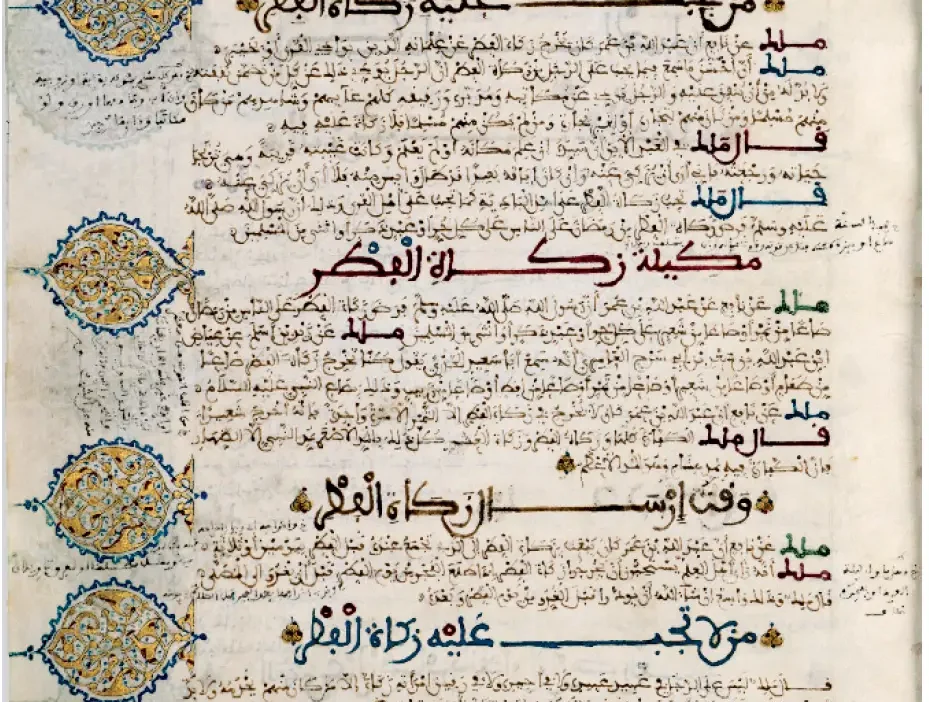
Image; Page from a manuscript of al-Muwaṭṭaʾ by Mālik ibn Anas (d. 795) (also called “Muwaṭṭaʾ Imam Mālik” on Wikipedia), dated to 1326, from Salé, Morocco.
Other spellings of names in this article: ʿAlī (Ali); Abū Bakr (Abu Bakr, Abu Bakar); Bukhārī (Bukhari); Taymiyya (Taymiyyah, Taimiyah); Qur’āniyyūn (Quraniyoon, Quranists); Makkah (Mecca); Qur’an (Quran, Koran).