
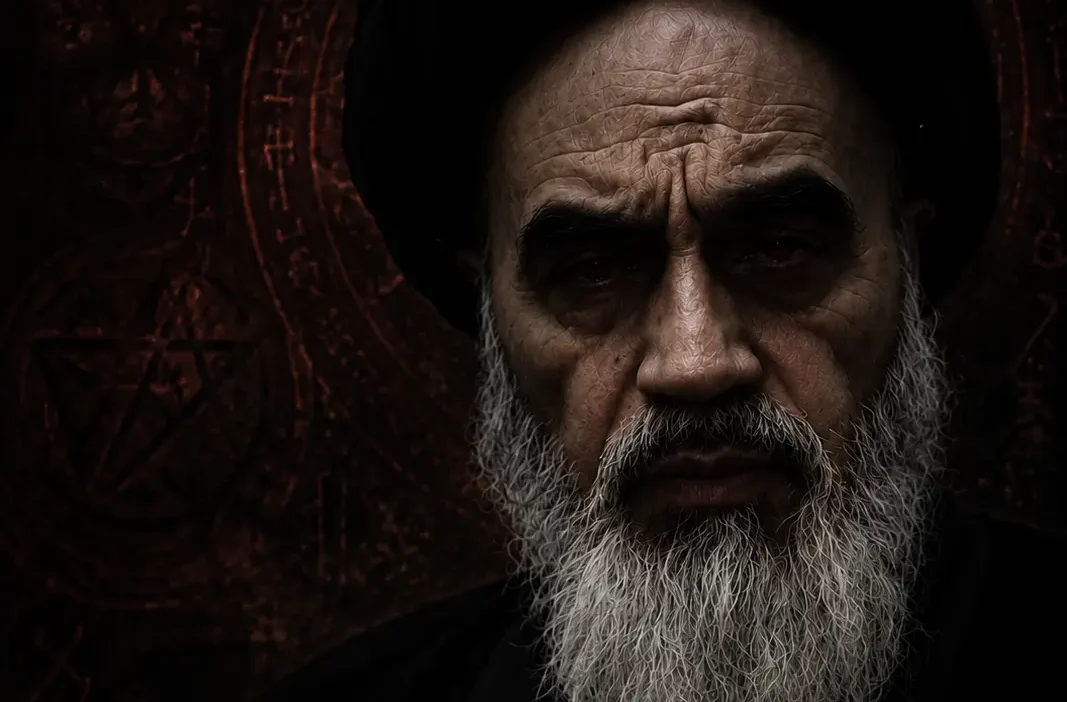
Ruhollah Khomeini (1902–1989) was an Iranian Shīʿī cleric who rose to lead the 1979 revolution that overthrew the Shah. He declared himself Supreme Leader, the first person in Shīʿī history to combine the roles of supreme religious authority and head of state, establishing a theocratic government based on Shīʿī principles. His rule was marked by brutal suppression of political opponents and the systematic persecution of Iranian Sunnis, including the execution of senior Sunni scholars, destruction of mosques, and exclusion of Sunnis from government. His writings, including Kashful Asraar and Hukumat-i-Islami, reveal beliefs that place him well outside the boundaries of Islam. Here are four facts about this man.
1. He doubts the Islam of the father-in- laws of the Prophet ; Abū Bakr and ʿUmar
“They, Abū Bakr and ʿUmar had nothing to do with Islam and Qur’an, except to seize worldly power, and had been using the Qur’an as a smokescreen to fulfill their evil intentions”1
2. He considers the 12 Imams to be greater than the Prophets.
“And an essential tenet of our Shīʿī sect is that the Imams have a position which is reached neither by the angels nor by any sent messenger of God.”2
3. He elevates the Imams to a position of divinity.
The Imam occupies a glorious station and a supreme place and wields such a delegated authority of genesis that everything in this universe submits to his surpassing glory.3
4. He holds the belief that the Qur’an has been distorted.
This can clearly be inferred by the fact that he praises the scholars and the books that clearly state that the Qur’an has been distorted. For example:
a) Nūrī Tibiris al-Ṭabarsī, one of the most renowned Shīʿī scholars wrote a book against the present Qur’an. The book is entitled: ‘Faslul Khiṭāb Fi Tahreefi-Kitabi Rabbil Arbaab’ (The Final Verdict on the Distortion of the Book of the Lord of Lords). Khomeini mentions this scholar with great respect in his own book ‘Hukumat-i- Islamiyah”
b) The canonical Shīʿī book, al-Kāfī by Kulaynī. The author of al-Kāfī brings tens of reports to support his claim that the Qur’an has been changed.
c) The book al-Wasā’il of al-Ḥurr al-ʿĀmilī who is of the same belief.
d) The book, al-Iḥtijāj of Aḥmad al-Ṭabarsī who is of the same belief.
Also see this article about Iran’s war against Islam.
Other spellings of names in this article: ʿUmar (Umar, Omar); Abū Bakr (Abu Bakr, Abu Bakar); Shīʿī (Shia, Shi’a, Shiite); Qur’an (Quran, Koran).