
The Quraniyun argue that hadith were written so long after the events that it is impossible to vouch for their authenticity. For example Ghulam Aḥmad Parvez states in his book Maqām-e–hadith: “there were no previous records that they [authors of the kutub siṭ̣ṭah] could have borrowed the material for their collections…how can anyone vouch for these kind of ahadith based on hearsay…not a single word could be guaranteed that it belonged to the Messenger.”
Thus, according to the Quraniyun, the existence of written records at the time (or close to the time of) the incident is key to proving that the incident actually occurred. This belief, that h̩adīth were transmitted orally for 200 years and then written down is common even amongst Muslims.
Reply to this misconception
Writing something doesnt guarantee its authenticity
Shaikh Mubarakpuri cogently states that:
the mere fact that something has been written does not provide sufficient proof for its being authentic. The basic foundation for trust is the reliability of the person through whom a report is delivered to others, no matter [whether] it is in written form or not.
In other words, a written document is not proof in itself, for the author may have either been a liar, a person with a weak memory, a person prone to scribal errors. On the other hand, an oral report from a trustworthy individual, with a good memory is widely accepted, even in a court of law.
Early written records of hadith did exist
In addition, his statement: “…there were no previous records that they [authors of the kutub siṭ̣ṭah] could have borrowed the material for their collections” is incorrect. To cite one example, Bukhārī made use of ‘Abd al-Razzāq’s book entitled Muṣannaf. Abd al-Razzāq compiled his Muṣannaf based upon written as well as oral material. His written sources include Ibn ‘Uyayna’s Kitāb al-Jawāmi’ f’ī l-sunan wa-l-abwāb. Ibn ‘Uyayna was the most accurate of Zuhrī’s students and was known for writing down the hadith that he heard from his teachers. Zuhrī in turn was able to access documents written in the time of the Prophet from the sons and grandsons of the Companions. He also narrated directly from companions such as Anas ibn Mālik who wrote down hadith from the Prophet.
The purpose of the above firstly refutes the statement that Bukhārī and his contemporaries had no written records to base their works on, and secondly it shows that a continuous written transmission of ahadith from Bukhārī all the way back to the Prophet existed.
The example above shows Bukhārī — Abd al-Razzāq— Ibn ‘Uyayna— Zuhrī— Anas ibn Mālik, where “—” shows transmission of written material.
Secondly, contrary to the Quraniyoon, there were multiple hadith works written before Imam Bukhari’s S̩ah̩īh̩.
List of extant hadith collections
In response to this claim we list a number of hadith compilations written pre- Bukhārī (d.256) which are all are extant.
- Muwaṭṭa’ of Mālik (d179)
- the Musnad of Abū Daūd al-Ṭayālisī (d203), Preserved in the Oriental library at Patna
- Ṣ̣ahīfah of Hammān ibn Munabbah (d110)
- the Muṣannaf of Abd al-Razzāq (d211),
- al-Jamī’ of Ma’mar ibn Rāshīd (d153), Preserved in, University of Ankara
- the ḥadīth collection of Juwairīyah bin Asmā from Nāfi’ (d173), Istanbul
- Al-Musnad by Zaid ibn ‘Ali (76-122).
- Musnad of Shâfi’i.
- Siyar of Awzâ’i (88-157).
- Musnad of ‘Abdullâh ibn al-Mubârak.
- Musnad of Abu Dâwûd Tayalisi (d. 204).
Bukhari’s access to written materials
Bukhārī had access to written hadith material. He stated that: “When I was to write a narration from a man, I would first ask his name, his kunayah, his descent/origin, and how he conveyed the ḥadīth, (and) if he was a person of sound comprehension. If not then I would ask him to bring out his original manuscript copy” [1]
Multitude of early hadith works
Azami states that in the first two centuries of Islam (i.e. prior to Bukhārī) there were literally thousands of hadith compilations in circulation. Most of them did not survive in their original form (often the written material was of poor quality), but were incorporated in the books of later authors [2]. Examples of this is the books of Ibn Jurayj, ath-Thawrī’ and Ibn ‘Uyayna which have been incorporated into the Muṣannaf of ‘Abd al-Razzāq as well as earlier books.
Al-Azami has produced a list of 437 scholars who had recorded hadith and all of them lived and died before the year 250 A. H.
Not extant does not imply non-existence
The Quraniyūn claim that none of these original early hadith collections are extant, and hence there is no proof that they actually existed. In reply many of the original manuscripts are extant.
Secondly, none of the original manuscripts of the Qur’ān (as dictated by the Prophet (salalahu alaihi wa sallam)) are available today. But the Quraniyūn would not claim that the Qur’ān was not written at the time of the Prophet due to lack of textual evidence. How do we know that the Prophet (salalahu alaihi wa sallam) dictated the Qur’ān as soon it was revealed? No verse in the Qur’ān orders the Prophet (salalahu alaihi wa sallam) to preserve the Qur’ān in writing.
Shaikh Mubarakpuri answers this question: “the very fact that the Prophet (salalahu alaihi wa sallam) got the revealed verses written down soon afterward, has come to us only through verbal narrations [i.e. the hadith], otherwise there is no source to know it…Now if hadith itself is not reliable, what is the source with us to confirm and prove that Holy Qur’ān was written during the period of the noble Prophet (salalahu alaihi wa sallam) [3]”
Notes:
[1] The Creed of the Imaam of Ḥadīth, Abū ‘Abdullah Muhammad bin Ismaa’eel al-Bukhārī and of the great scholars from whom he narrated.
[2] al-Azami, M. Mustafa. (1992). Studies in Early Hadīth Literature. Page 75
[3] Mubarakpuri, Safiur-Raḥmān. (2005) In reply to the mischief of the denial of Hadīth, page 55-6
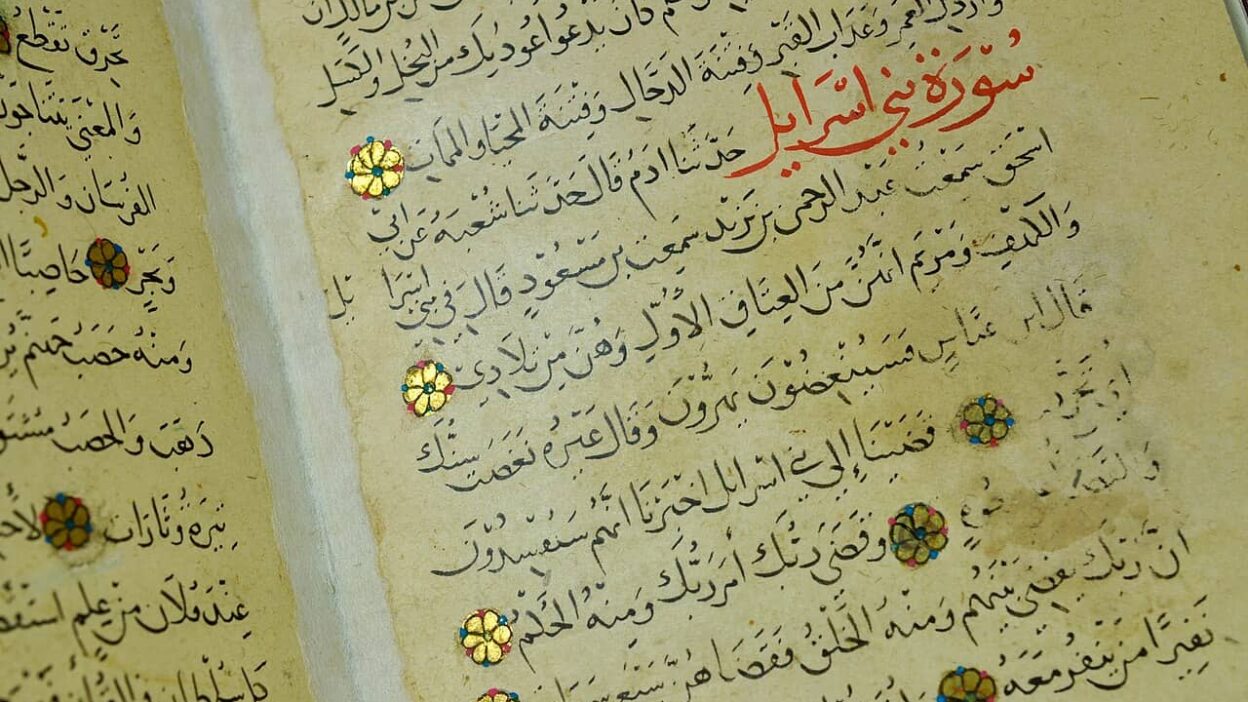
Image. A manuscript copy of Hadith by al-Bukhari, Mamluk era, 13th century, Egypt. Adilnor Collection, Sweden. CC BY-SA 4.0 via Wikimedia Commons.
.