
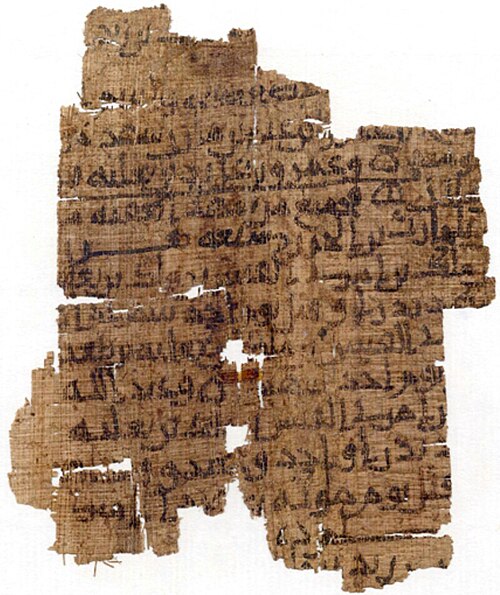
The earliest extant manuscript of The Sirah Of Prophet Muḥammad by Ibn Hisham. Unknown scribe., Public domain, via Wikimedia Commons
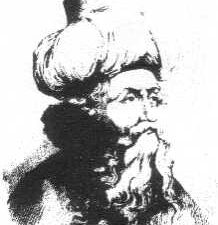
This is a short biography of the famous historian Muhammad bin Ishaq, author of the famous Sirat Rasul Allah, which is one of the oldest extant texts on the biography of the Prophet.
Lineage
His full name is Muhammad bin Ishaaq bin Yasaar bin Khiyaar. He was affiliated with the Quraysh tribe through his client status with Qais bin Makhrama bin Al-Muttalib bin Abd Manaf. His kunya was Abu Abdullah.
His grandfather, Yasaar, was a Christian Arab, taken prisoner at ʿAyn al-Tamr in Iraq in 12/633-4 and, according to Yaaḳut and al-Baghdadi, was one of the first captives sent by Khalid b. al-Walid to Abu Bakr in Medina. Yasaar later embraced Islam and was set free. He had three sons – Musa, ʿAbd al-Raḥman, and Isḥaq, all of whom were narrators of akhbar. One of Ishaq’s sons was Muhammad Ibn Ishaq, born in 85 / 704.
Pursuit of knowledge
Ibn Ishaq became renowned for his vast knowledge, sharp intellect, and exceptional memory. He was a dedicated scholar, historian, and genealogist. He is famously known for his “The Biography of the Prophet” (al-Sirah). This work became a foundational text for later biographies of Prophet Muhammad (salalahu alaihi wa sallam). Ibn Ishaq had the opportunity to see Anas bin Malik and Saeed bin Al-Musayyab in Medina; both important figures in the early Islamic period.
Ibn Ishaq travelled extensively, seeking knowledge and documenting historical accounts. He visited Alexandria, Kufa, al-Jazira, Rayy, al-Hirah, and eventually settled in Baghdad, where he died.
He narrated accounts from his father, his uncle Musa bin Yasar, and other scholars including Abaan b. Uthman b. Affan, ‘Asim b. Umar b. Qatada, Abdullah b. Abi Bakr ibn Hazm, Ibn Shihab al-Zuhri, Bashir bin Yasar, Tawus ibn Kaysan a1nd Saeed bin Abi Hind. Many of the aforementioned scholars also authored historical works. These were incorporated into later historical works, including Ibn Ishaq’s al-Sira. Al-Zuhrī said Medina would never lack for ‘ilm as long as Ibn Ishaq was there, and eagerly sought from him details of the Prophet’s campaigns.2
Ibn Ishaq in the eyes of hadith critics
Early Muslim hadith critics overall assessment of Ibn Ishaq was positive.
- Al-Zuhri, (d 124/741-2) said that he was “the most knowledgeable of men in Maghazi.”3
- S̲h̲uʿba ibn al-Hajjaj regarded him as “amir al-muʾminin in tradition.”4
- Abū Zurʿa, Ali b. al-Madini, Ibn Maʿīn and Ibn Saʿd regarded him as sound in tradition.
- Imam al-Shafi’i said about him, “Whoever wants to delve deeply into military expeditions (of the Prophet) is dependent on Muhammad ibn Ishaq.
- Al-Dhahabi said in Siyar A’lam al-Nubala’: “He was the first to document knowledge in Medina, before Malik and his followers. He was a vast ocean of knowledge, but he was not as prolific as he should have been.”
- Al-Hafiz Ibn Hajar said in Taqrib al-Tahdhib, “He was the imam of military expeditions, and for this reason al-Bukhari included a number of hadiths on his authority in his Sahih.”
On the other hand, al-Nisaʾi and Yaḥya b. Qaṭṭan did not accept him in matters of hadith Ibn Ḥanbal, whilst accepting him on matters relating to mag̲hazi, did not draw upon him for hadith because he objected to his use of the collective isnad: “I see him relating on the authority of a group of people a single hadith, and he does not distinguish the words of this one from the words of that.”5 Others criticised him for his reliance on Isra’iliyat.
Beyond the isnād-related criticisms, Duri records that Ibn Ishaq was also criticised for errors in genealogies and for passing on material from other writers’ books without having heard it directly from them. In his defence, Duri notes Ibn Ishaq did sometimes express doubt about his own accounts and would corroborate them with Qurʾanic verses; he was also self-aware about being weak in poetry.6
The Sirah
It was in Baghdad that he compiled al-Sirah for the Abbasid Caliph al-Mansur’s son, al-Mahdi, “Al-Sirah” is a comprehensive account of the life of Prophet Muhammad, tracing his lineage, major events, and teachings. It is considered a crucial source for understanding the early history of Islam, particularly the prophetic period.
Uniqueness and Structure of al-Sirah:
Ibn Ishaq’s “al-Sirah” holds a distinctive place in Islamic historiography due to several factors:
- Comprehensive Scope: It provides one of the earliest and most comprehensive accounts of the life of Prophet Muhammad, encompassing his birth, early life, prophetic mission, migration to Medina, battles, interactions with other tribes, and death.
- Narrative Style: Ibn Ishaq employed a narrative style that incorporated various sources, including hadith, historical reports, poetry, reports from story tellers, and Isra’iliyat.
- Chronological Order: Al-Sirah presents events in a generally chronological order, which helped to establish a framework for understanding the development of early Islam. This structured approach was influential in shaping subsequent biographical works on the Prophet Muhammad.
Scholars have debated the internal structure of al-Sīra. Duri notes that its design probably consisted of three parts; the Mubtadaʾ (history from Creation to Muhammad’s call), the Mabʿath (his mission), and the Maghāzī (his campaigns), though Duri himself argues the work in practice comprised only two distinct parts, the Mubtadaʾ and the Maghāzī, which could be transmitted together or separately.7 In the Mubtadaʾ, Ibn Ishaq drew heavily on the ahl al-kitāb and converts to Islam, and derived much of his material on pre-Islamic and Yemenite history from Wahb ibn Munabbih where Duri notes this Isrāʾīliyāt material entered historical writing specifically “through the influence of Wahb ibn Munabbih, primarily on Ibn Ishaq.”8
A separate, largely lost work, a Taʾrīkh al-khulafāʾ (“History of the Caliphs”) covering the Rāshidūn and Umayyad caliphs, has also been attributed to Ibn Ishaq, though only scattered selections survive. Taken together with the Mubtadaʾ and Maghāzī, this points to Ibn Ishaq working toward something like a conception of universal history.9
The book is structured around the key phases of Prophet Muhammad’s life:
- Pre-Islamic Arabia: Accounts of the social, religious, and political conditions in Arabia before the advent of Islam.
- Early Life in Mecca: Stories of Prophet Muhammad’s birth, childhood, and early adulthood.
- The Prophetic Mission: The beginning of his revelations, the initial opposition he faced, and the early struggles of the nascent Muslim community.
- The Hijra (Migration to Medina): The pivotal event of the migration to Medina and the establishment of the first Islamic community-state.
- Life in Medina: Battles, treaties, interactions with other tribes, and the development of Islamic law and society.
- Conquest of Mecca: The triumphant return to Mecca and the consolidation of Islam’s position in the Arabian Peninsula.
- Final Years and Death: The Prophet Muhammad’s final pilgrimage and his death.
His death
Ibn Ishaq remained in Baghdad until his death and was buried in the Khayzuran cemetery near the grave of Abu Ḥanifa. The exact year of his death is debated, with estimates ranging from 150 to 153 AH (approximately 767 to 770 CE).
Concluding remarks
Ibn Ishaq’s “Biography of the Prophet” is considered a crucial source for understanding the early history of Islam, particularly the prophetic period. However, the original work has not survived intact.
The text that has reached us today is derived from Ibn Hisham (d. 218/813 CE), who produced a revised and abridged version of Ibn Ishaq’s al-Sira. Ibn Hisham’s revision was based specifically on the recension of al-Bakkāʾī; one of several separate transmission lines through which Ibn Ishaq’s original material was passed down. Al-Sakhāwī judged al-Bakkāʾī’s recension superior to the rival recension of Yūnus ibn Bukayr al-Shaybānī, which survives independently of Ibn Hisham’s text. 10 Duri also notes that the Sīra was initially criticised in Medina but was received considerably more favourably in the eastern provinces.11
Ibn Hisham’s revised version was made more compatible with the approach of hadith scholars: for example, he removed fabricated poetry from Ibn Ishaq’s original narrative.
Beyond Ibn Hisham’s own recension, Guillaume traces several other copies of Ibn Ishaq’s original work that circulated independently and were drawn on by later historians to supplement or check Ibn Hisham’s version. One copy, made while Ibn Ishaq was in Ray, was transmitted by Salama b. al-Fadl al-Abrash al-Ansari and is the version al-Tabari relied on. A third copy was made by Yunus b. Bukayr, also in Ray, and was later used by Ibn al-Athir in his Usud al-Ghaba; a portion of this recension reportedly survives in the Qarawiyin mosque in Fez. A fourth copy belonged to the Syrian scholar Harun b. Abi ‘Isa and was used by Ibn Sa’d. Separately, the Fihrist also mentions a further edition by al-Nufayli.12
- Guillaume, p. xiii ↩︎
- ibid ↩︎
- ʿUyun al-at̲h̲ar , i, 8 ↩︎
- Tahdhib, ix, 44 ↩︎
- Tahd̲h̲ib, ix, 43 ↩︎
- Duri, p. 35 ↩︎
- Duri, p. 33 ↩︎
- Duri, p. 34; cf. p. 157, ↩︎
- Duri, pp. 36–37. ↩︎
- Duri, p. 36 ↩︎
- Duri, p. 36 ↩︎
- Guillaume, p. xvii ↩︎
References
A Survey of Early Muslim Historiography. The Muhidin Mulalic
The Rise of Historical Writing Among the Arabs. A. A. Duri
The Origins and Development of Muslim Historiography. M. G Rasul