
Last reviewed: · How we correct articles
In this three part series, we examine the life of ʿUthmān ibn ʿAffān (may Allah be pleased with him), his virtues, his achievements and the events leading to his martyrdom.
Early life
ʿUthmān ibn ʿAffān was born six years after the Prophet. In jaahilyah he was among the best of his people. He was of high status, very wealthy, extremely modest and eloquent in speech. He never prostrated to any idol, nor did he ever commit an immoral act, nor did he ever drink alcohol or listen to music. He had a very high status in Jāhiliyya, and was well versed in lineage, proverbs and customs on non-Arabs.
- ʿUthmān was one of the first to accept Islam, aged 34, after Abū Bakr, ʿAlī, and Zayd ibn Ḥārith.
- He was the first of the ummah to migrate to Abyssinia with his wife Ruqayya.
- He was one of the ten promised Paradise.
- ʿUthmān formed a very close relationship with Prophet Muhammad, and he gained intricate knowledge about the religion of Islam. He narrated 146 traditions directly from the Prophet himself and was one of very few people who were able to write down Qur’an. ʿUthmān also became a reference point for those trying to learn the rituals of worship.
- In terms of lineage, ʿUthmān closer to Prophet ﷺ than Abū Bakr and ʿUmar He was the Prophet’s third cousin; his lineage coincided with Prophet at ʿAbd Manāf.
His virtues
- Zuhrī said: ʿUthmān supplied the army of Tabūk with 940 camels, and 60 horses. He also brought 10,000 dinars (approx. 4kg of gold) to equip the army and placed the money before the Messenger of Allah (sa) and the Messenger (sa) began turning it over with his hand saying, “No deed can harm ʿUthmān after today” twice. (Tirmidhī)
His marriage
- Because of his conversion to Islam, ʿUthmān had to separate from his wives, who refused to accept Islam. He was grieved and distressed by this, but his love for Islam was of more value to him. The Prophet was so impressed by his sacrifice, that he married his second daughter, Ruqayya, to ʿUthmān. However, the marriage was short lived. Ruqayya was taken ill at a time when the Muslims went to war at Badr and subsequently passed away when the Prophet and the Muslims were fighting the Quraish at the battlefield of Badr. Deeply grieved by the loss, ʿUthmān was asked by the Prophet to marry his other daughter, Umm Kulthūm. When she too passed away six years later, the Prophet noted ʿUthmān’s grief in his manner of walking and expression on his face and said: “Had we a third daughter, surely, we would have given her in marriage to you.”
- The marriage to two daughters of the Prophet had earned ʿUthmān the nickname Dhū al-Nūrayn (the one with the two lights) as there was no one else had the privilege of having the Prophet as a father-in-law twice over. In fact no man in history married two daughters of a Prophet.
His generosity
- When the Prophet ﷺ came to Madinah he found that there was no source of fresh water in Madinah except the well of Bi’r Rūma. Before the arrival of the Prophet ﷺ, no one could drink from Bi’r Rūma except in return for payment. Rūma was a spring that belonged to a Jew who used to sell its water to the Muslims The Messenger of Allah ﷺ said: “Who will buy Bi’r Rūma and share it with the Muslims in return for reward in Paradise?” [al-Bukhārī]. ʿUthmān ibn ʿAffān bought it from the Jew for twenty thousand dirhams and donated it for the rich and poor and wayfarers. (Tirmidhī)
- When the mosque became too small for the people, and the Prophet asked some of the Ṣaḥāba to buy the land next to the mosque so that the mosque could be expanded and made big enough to accommodate all the people. He said: ”Who will buy the land of so and so and add it to the mosque in return for something good for him in Paradise ?” ʿUthmān ibn ʿAffān bought it with his own money for twenty-five thousand dirhams, or for twenty thousand, then it was added to the mosque, which then became large enough to accommodate the Muslims.
Qualities unique to ʿUthmān
- With regard to al-Ḥudaybiyya, al-Ṭabarī mentioned a number of qualities that were exclusive to ʿUthmān. For example, he was the only one for whom the hand of the Prophet ﷺ represented his hand, when the Ṣaḥāba swore allegiance and ʿUthmān was absent. He was the only one who conveyed the message of the Messenger of Allah to the Muslim prisoners in Makkah, and the Prophet approved of ʿUthmān’s refusal to perform ṭawāf when he sent him with that message.
- ʿĀʾisha said: The Messenger of Allah was lying down in my house with his thigh or shin uncovered. Abū Bakr asked for permission to enter and he let him in whilst he was in that state, and he spoke to him. Then ʿUmar asked for permission to enter and he let him in whilst he was in that state, and he spoke to him. Then ʿUthmān asked for permission to enter and the Messenger of Allah sat up and straightened his garment. When he left, ‘ ʿĀʾisha said: Abū Bakr came in and you did not stir for him, and ʿUmar came in and you did not stir for him, then ʿUthmān came in and you sat up and straightened your garment. He said: “Should I not feel shy before a man before whom the angels feel shy?“ [Muslim]
ʿUthmān the martyr
- The Prophet ﷺ once climbed the mountain of Uḥud with Abū Bakr, ʿUmar and ʿUthmān radhiallahu `anhum. The mountain shook with them. The Prophet said (to the mountain), “Be firm, O Uḥud! For on you there are no more than a Prophet, a al-Ṣiddīq and two martyrs.” (al-Bukhārī)
- It was narrated that Abū Mūsā said: I was with the Prophet in one of the gardens of Madinah when a man came and asked for the gate to be opened. The Prophet said: “Open the gate for him and give him the glad tidings of Paradise.” I opened the gate and saw it was Abū Bakr, and I gave him the glad tidings of what the Messenger of Allah had said, and he praised Allah. Then another man asked for the gate to be opened, and the Prophet said: “Open the gate for him and give him the glad tidings of Paradise.” I opened the gate and saw it was ʿUmar, and I gave him the glad tidings of what the Messenger of Allah had said, and he praised Allah. Then another man asked for the gate to be opened, and (the Prophet) said: “Open the gate for him and give him the glad tidings of Paradise in return for a calamity that will befall him.” It was ʿUthmān, and I told him what the Messenger of Allah had said, and he praised Allah, then he said: Allah is the One Whose help I seek. [al-Bukhārī]
His selection as Caliph
After his fatal stabbing, ‘ʿUmar chose a panel of six men to decide on his successor from among themselves. The six were: ʿUthmān, ʿAlī, Saʿd ibn Abī Waqqāṣ, Ṭalḥa, Zubayr and ʿAbd al-Raḥmān ibn ʿAwf. When the members of the shūrā council had assembled, ʿAbd al-Raḥmān ibn ʿAwf said to them: ‘Delegate the matter to three among you’. Al-Zubayr said: ‘I delegate my say to ‘ʿAlī’. Ṭalḥa said: ‘I delegate my say to ‘ʿUthmān’. Saʿd said: ‘I delegate my say to ʿAbd al-Raḥmān ibn ‘ʿAwf’. So now there were three candidates: ʿAlī ibn Abī Ṭālib, ʿUthmān ibn ʿAffān and ʿAbd al-Raḥmān ibn ʿAwf. ʿAbd al-Raḥmān ibn ʿAwf withdrew from the contest and obtained the agreement of the others to be given authority to choose the Caliph.
ʿAbd al-Raḥmān ibn ʿAwf began to contact people and consult for three whole days. He started with ʿAlī ibn Abī Ṭālib, and said to him: ‘If I do not choose you, then tell me who you would nominate for caliph’. ʿAlī said: ʿUthmān ibn ʿAffān. ʿAbd al-Raḥmān then went to ʿUthmān and said to him: ‘If I do not choose you, who would you nominate for caliph?’ ʿUthmān said: ʿAlī ibn Abī Ṭālib.
After that Ibn ʿAwf went to the other Ṣaḥāba and consulted them, and he consulted each of the senior Ṣaḥāba whom he met in Madinah, as well as the commanders of the army, and visitors to Madinah. His consultation also included women in seclusion, who expressed their views, as well as children and slaves in Madinah. The outcome of his consultation was that all of Muslims agreed upon ʿUthmān ibn ʿAffān. He announced this to Companions and made bayʿa to ʿUthmān followed by ʿAlī and then the other four. The bayʿa to ʿUthmān unanimous. Imam Aḥmad said this was no unanimous bayʿa like the one of ʿUthmān.
In this part, we examine the achievements of ʿUthmān during his caliphate. ʿUthmān’s reign lasted twelve years, from 644 to 656 C.E (24H – 35H). The first six years of his reign were trouble free. Although his caliphate ended tragically, his reign can be considered successful from a number of different angles: military, religious and economic.
The military front
One of ʿUthmān’s lasting legacy was the territorial expansion of the Muslim Caliphate. The development of a highly efficient navy contributed to this military success. News of the murder of ʿUmar encouraged the enemies of Islam, especially the Persians and the Byzantium’s to regain the lands that the Muslims had conquered. ʿUthmān’s first challenge as Caliph was to thwart the Byzantine counter offensives against land conquered in the time of ʿUmar. The Byzantine attack was on two fronts; against Alexandria in Egypt which they captured with very little resistance and Syria. ʿAmr ibn Al-ʿĀṣ defeated the Byzantium army as it marched from Alexandria to capture Fustat. He then laid siege to Alexandria and managed to recapture the city.
Defence of Sham
The Byzantines sent 80,000 men to recapture Syria. ʿUthmān wrote to Walīd ibn ʿUqba in Kufa telling him to send reinforcements to their brothers in Syria. He sent 8,000 men and the Byzantines were repelled with the Byzantine commander killed. Following the Byzantine defeat, Muʿāwiya, the governor of Syria decided to go on the offensive. Without a naval force, the Syrian and Egyptian coasts were vulnerable to Byzantine attack. Muʿāwiya persuaded ʿUthmān to overturn the decision of his predecessor ʿUmar, and to give permission for a naval fleet to be built. However he stipulated that no soldier should be compelled to join the navy.
The conquest of Cyprus
Although Muʿāwiya did not force anyone to join him, a huge army of Muslims set out with him. In 28H, a fleet of 500 ships was sent to Cyprus. The latter was an important Byzantine naval base. Muʿāwiya wrote to the people of Cyprus calling them to Islam, stating that their aim was not to take over their island, but to secure the Muslim borders in Syria, as the Byzantines were using Cyprus as a launch pad and supply route for their armies to attack Syria.Initially the Cypriots agreed to pay the jizya and signed a treaty with the Muslims. However a few years later they broke their treaty and aided the Byzantine navy against the Muslims. Muʿāwiya launched a full-scale attack on Cyprus attacking it from the both sides killing many people and captured many prisoners.
When Cyprus was conquered Abū Dardāʾ, sat alone and cried. Jubayr ibn Nufayr approached and asked, “What makes you cry on this day in which Allah has strengthened Islam and its people?” Abū Dardāʾ replied, “Woe be to you O Jubayr. How insignificant the creation is to Allah when they abandon His commands. Between us is a nation, who were evidently strong and had dominion, they abandoned the commands of Allah, so see what has become of them!“
Six years after the construction of the first ever Muslim navy, Byzantine naval supremacy in the Mediterranean came to an end in a decisive battle known as the Battle of the Masts. The Byzantine navy of 500 ships was commanded by the Constans II against a Muslim fleet of 200. The naval encounter off the coast of southern Turkey ended in disaster for the Byzantines, and Constans fled to the island of Syracuse where he was killed by the locals.
Conquests in the East
The Eastern part of the Caliphate expanded significantly under the military leadership of ʿAbdullāh ibn ʿĀmir, the governor of Basra. After crushing an internal rebellion in Persia, he led an army to Khurasan conquering Nishapur, Harat, Merv and Balkh. The fall of Balkh ensured the whole of Khurasan came under Muslim control. The Muslim army continued eastwards and Kabul was captured.
North Africa
A large part of North Africa was also captured in the early part of ʿUthmān’s reign under the leadership of the governor of Egypt; ʿAbdullāh ibn Saʿd. Tripoli, an important Byzantine stronghold first fell to the Muslim forces, followed by Sufetula, the capital city of the Byzantine governor Gregory. The latter was killed, and the Muslims went further west to capture Tunisia, Morocco and parts of Algeria.
The Caucasus
Northwards from Iraq, Armenia and Ădharbayjān were re-captured following a rebellion. The Muslim army pushed further north after defeating the Romans, making their presence felt in the Caucasus regions and capturing a large swathe of land west of the Caspian Sea. Thus the reign of ʿUthmān witnessed some astonishing military successes. The Islamic empire continued to expand, with the conquest of Cyprus, Anatolia, Khurasan, Afghanistan, Samarkand, Tashkent as well as Libya, Algeria, Morocco and Tunisia.
Wealth pours in
These military victories brought immense wealth to the Caliphate in the form of booty and land tax. For example, the land tax (kharāj) from Egypt alone was four million dinar. ʿUthmān retained some, but not all of the economic policies of ʿUmar. ʿUmar had decreed that conquered land was not to be divided up amongst the army, but would remain with the local population as official state land. The local farmers paid a tax (fay’) on this land according to the income derived from it. ʿUthmān continued this policy causing consternation among sections of the army.
However ʿUthmān increased the stipends paid to those who had participated in the wars of conquest (ahl al fay’) by 25%. ʿUthmān also lifted the restrictions placed by ʿUmar on the purchase of land in the conquered territories. Taking advantage of loans from the public treasury, many Companions purchased agricultural land in Iraq causing jealously among some of the local population and this resentment was later exploited by those who wished to challenge the Caliph’s authority. ʿUthmān also continued the programme of public works started by his predecessor ʿUmar, and had numerous canals dug for agricultural purposes as well as masjids, rest houses for travellers and schools.
Standardisation of the Qur’an
One of the greatest achievements of ʿUthmān is his decision to unite the Muslims on a standard text of the Qur’an. Ḥudhayfa ibn Yamān noticed that the disagreement about recitation of the Qur’an had emerged among the armies engaged in battle in Azerbaijan. He returned to Madinah in 25H to inform ʿUthmān about this alarming development, saying: ‘O Commander of the Faithful, save this ummah before it disagrees about its Book, like the Christians and Jews did before it’. (al-Bukhārī). ʿAlī narrated that ʿUthmān assembled the Companions and said: ‘I see that we bring the people on a single muṣḥaf, so that there is neither division nor discord’. And we said: ’an excellent proposal’
Zayd ibn Thābit was chosen to lead a committee of four Companions renowned for their scholarship of the Qur’an, in order to make official copies from the mushhaf held by Ḥafṣa, daughter of the late Caliph ʿUmar. Seven copies in total were made and were sent to the various regions with an official reciter. With every copy of the Qur’an, ʿUthmān sent a qari to teach it. This was to emphasise that the recitation of the Qur’an had to be learnt orally through a teacher who had an authentic transmission going back to the Prophet ﷺ. Recitation could never be solely based on the text. The script itself was in the Kūfī script without nuqat and tashkeel. All other manuscripts were destroyed, and all new copies were to be made from the official copy, known as the Mushhaf ʿUthmān. Another significant religious event in the reign of ʿUthmān was the extension of the Prophet’s mosque in 29H.
In part two, we discuss the beginning of the fitna that led to the unjust killing of ʿUthmān.
Based on The Biography of ʿUthmān Ibn ʿAffān – Dr. Ali Muhammad Sallabi
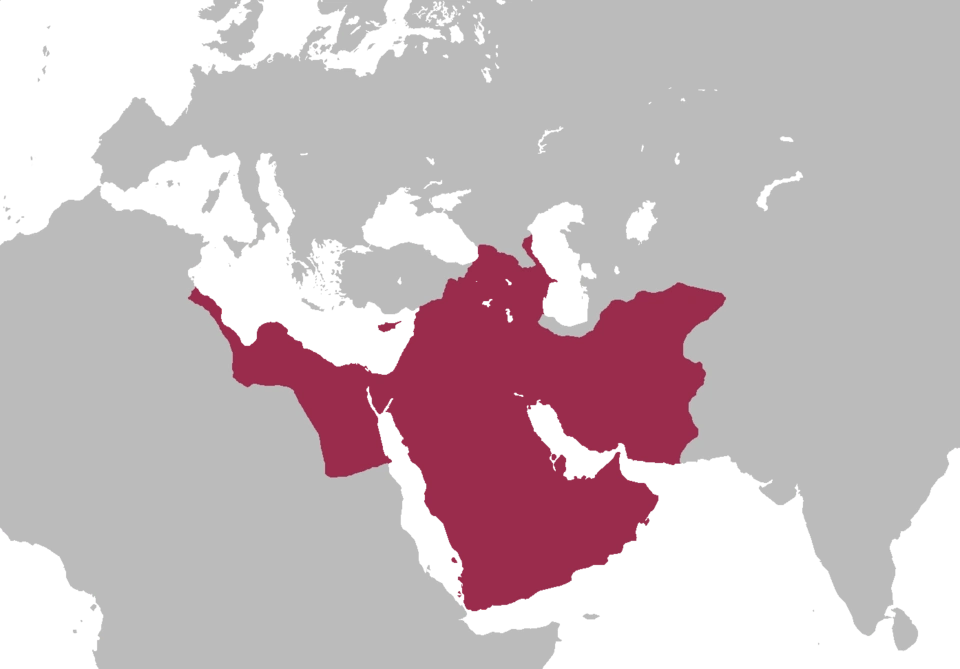
Image: Map showing the maximum territorial extent of the Rāshidūn Caliphate c. 656 CE, at the end of ʿUthmān ibn ʿAffān’s caliphate. By Kaiser&Augustus&Imperator, CC BY-SA 4.0 via Wikimedia Commons.
Other spellings of names in this article: ʿUthmān (Uthman, Usman, Othman); ʿUmar (Umar, Omar); ʿAlī (Ali); Abū Bakr (Abu Bakr, Abu Bakar); ʿĀʾisha (Aisha, Ayesha, Aishah); Muʿāwiya (Muawiya, Muawiyah); Khaṭṭāb (Khattab); ʿAffān (Affan); Abī Ṭālib (Abi Talib); Ṭabarī (Tabari); Bukhārī (Bukhari); Ḥudaybiyya (Hudaybiyyah, Hudaibiya); Makkah (Mecca); Madinah (Medina).