
A. Introduction
In this article we study the topic of Hadeeth and Sunnah, giving various scholarly definitions of both terms. But why is it important to study this topic ? There are four main reasons:
1. Misconception regarding the word “Sunnah. Many perceive Sunnah as meaning “it is not obligatory” or “if you do it, it is good”. This leads to erroneous beliefs such as: Whatever in Qur’aan we should follow and Sunnah is just recommended.
2. Groups such as the ‘Qur’aaniyoon’ claim that Sunnah is not required. They give elaborate arguments to support their view. Though most Muslims don’t follow the Qur’aaniyoon, some are influenced by them.
3. Doubts raised by orientalists and missionaries. These people fully realise the importance of the Sunnah to Islam. They are not able to openly attack Qur’aan as no Muslim would follow them in this. However, due to the fact that the average Muslim’s knowledge of Hadeeth is very limited, they have found this to be an opening by which to attack Islam.
4. Understanding role of Sunnah is important part of understanding of this Deen
a) It will serve as an encouragement in studying Hadeeth in greater detail.
b) It helps getting closer to Allah and the Prophet and thus increases one’s faith.
Sunnah is a term that has different meanings depending on the type of scholar using it. In fact, one of the first sources of confusion regarding the word sunnah and its importance is the different usages of the word sunnah.
B. Definitions
Lexically, sunnah refers to the “flow and continuity of a thing with ease and smoothness” This original usage of the word paved the way for Lane’s definition:
“a way, course, rule or manner, of acting or conduct of life or the like… whether good or bad; approved or disapproved…a way that has been instituted or pursued by former people, and has become one pursued by those after them”.
Hence linguistically, Sunnah is either a way or path, regardless of if it is good or bad, or a manner, habit, or conduct. In its technical sense, sunnah has a number of different meanings.
i) Sunnah and Aqeedah
Around the third century Hijra, specialists in aqeedah started using the word Sunnah to refer to the correct Aqeedah and worship, as opposed to innovations, which is why many scholars refer to their books on Aqeedah as ‘the Sunnah,’ like ‘As-Sunnah‘ of Imam Ahmed, ‘Sharhus-Sunnah‘ by al-Barbaharee.
ii) Opposite of Bida’
Some scholars would use Sunnah as the opposite of bida’. In this definition, Sunnah refers to anything that is sanctioned by the Shariah whether its from the Quran, the practice of the Prophet, or the ijmaa of the Companions. So we hear scholars saying, so and so is upon the Sunnah, meaning with respect to his aqeedah and manhaj.
iii) Definition of the jurists
According to the jurists, the sunna is a recommended act, also commonly known as mandūb. Hence an act of the Prophet that was either obligatory upon the Muslim, or permissible would not be ‘sunna’ according to the jurists.
iv) Definition of the Muhaditheen
The topic of study for the Muhaditheen1 is everything that has been authentically narrated or reported concerning the Prophet. Hence they concentrate on any information narrated about him, and therefore their definition of Sunnah is the broadest. According to the Muhaditheen, sunna is:
“what has been passed down from the Prophet, peace be upon him, of his statements, actions, tacit approvals, manners, physical characteristics, or biography, regardless of whether it was before he was sent as a prophet or afterwards”
An example of the Muhaddith usage of Sunnah is: The Prophet had approximately 20 grey hairs. Or that he was more bashful than the virgin girls kept in their private apartments. Or he married Khadija when he was 25 years old. Note that many of the reports that fall under the Muhaditheen’s definition of sunnah have no bearing on Islamic law.
C. Definition of Sunnah according to the Usooliyeen
The definition that interests us for the purpose of this lecture is that given by Usooliyeen (legal theorists). Their task is to determine what is an authority in Islamic law. In other words, what reports are an example for the Muslims to follow. They are not concerned with the details of the actual law, but they are concerned with the sources of that law. They define the Sunnah as:
the statements, actions, and tacit approvals of the Prophet after he received revelation, but not including the Quran.
His statements include what he commanded, recommended, permitted, disapproved, or forbade. His actions only include selected actions, as not all of the Prophet’s actions are considered examples to be followed.
Notice that the Usooli definition of Sunnah is the same as the Muhaddith definition minus the physical attributes of the Prophet and also subtracting anything that happened to the Prophet before becoming a Prophet, as such things would not be considered an authority in Islamic Law.
Physical attributes of the Prophet before Prophethood do not have any weight in legislation found in the Shari’ah, so this is left out. But the Muhaditheen are concerned with anything pertaining to the Prophet, so they include what the Usoolis have omitted.
Difference between muhadditheen and usooliyoon definition
An example to illustrate the difference between the muhadditheen definition and usooliyoon definition is the hadith that mentions that the Prophet used to snore lightly. According to the usooliyoon, this hadith has no bearing on Islamic law, i.e., the Muslim is not required to follow it, and therefore this action of the Prophet is not considered to be a Sunnah. However, the muhadditheen would include this within their definition of the Sunnah.
D. The Sunna as a source of law
The sunna, according to this definition, is a source of Islamic law, equal to that of the Qur’ān with regard to rulings and obligatory to follow. The Prophet (sallalahu alayhi wa sallam) said, “I am leaving you two things; if you stick to them, you will never go astray: the Book of Allah and the sunna of His Prophet.” To better understand each element of the Sunnah, examples of ahadeeth of each type are defined below:
i. Statement: Something the Prophet literally said. We find that the majority of ahadeeth that exist are actual statements of the Prophet. Example: “Actions are only by intentions…”
ii. Action: a Companion saw the Prophet (sallalahu alayhi wa sallam) performing an action. We find that the second largest amount of ahadeeth preserved are actions performed by the Prophet.
iii. Approvals: An action or statement that took place during the time of the Prophet and was known to the Prophet (sallalahu alayhi wa sallam) in which there was no objection. Because the Prophet remained silent, this is considered a tacit form of acceptance of the action or statement of a sahabah.
One might ask the question, what if a sahaba did something that the Prophet didn’t see or was unaware of? To address this, we know that Allah sees everything, and if there was something that needed to be addressed, Allah would have revealed Qur’an to the Prophet.
E. Sunnah vs Hadith
What exactly is a hadith? Is it the same thing as Sunnah? In some contexts, hadeeth and sunnah are used interchangeably. For example, if someone were to say our religion is to follow the Qur’an and Hadith, this would be equivalent to saying “follow the Qur’an and Sunnah.” But to be more precise, a distinction should be made between the two.
Hadith is linguistically defined as “speech” or “something new.” Accordingly to Islamic terminology, Hadith is defined as: The means by which the Sunnah of the Messenger of Allah reaches us. So a hadith is any report of the Prophet’s sayings, actions, approvals, manners, physical characteristics, or b. of two parts: isnaad (chain of authorities) and matn (the actual text of the hadith). Both of these parts have to meet stringent requirements for the hadith to be accepted.
The accepted hadith are the Sahih and Hasan. The rejected hadith are daeef and mawdoo. For a hadith to be considered Sahih it must meet five conditions:
a) Unbroken isnad
b) Each narrator in the chain must be upright and righteous
c) Each narrator must be precise when narrating with a strong memory
d) The hadith must not contradict a stronger hadith
e) There should be no hidden defects in the hadith.
Relationship between Sunnah and Hadith.
The Sunnah is the reality, or the actual statements, actions and approvals of the Prophet. There is no such thing as a weak Sunnah. That actual Sunnah is contained within the reports that have come down from the Prophet. The Hadith is the vehicle by which the Sunnah reaches us since we were not present at the time of the Prophet. Hadīth is the ‘carrier’ and ‘vehicle’ of the sunna…it has can said that a certain ḥadīth contains five sunnas”
However not everything reported from the Prophet is correct – some are blatant lies and fabrications, and hence not all hadith represent the Sunnah. Only the acceptable hadith represent and portray the real sunnah of the Messenger.
Shaikh Albanee said: “The sunnah that has importance in the law is the confirmed sunnah from the Prophet (sa) via methodological means and well-known sound chains according to the people of knowledge of hadith and its narrators. It is not one that is found in the various books of tafseer, books of fiqh, and books of stories to make the heart soft. In these are many weak, rejected, and fabricated hadith. It is incumbent upon the people of knowledge not to be so bold as to argue by hadith until after they certify its truthfulness.”
F. The authority of the Sunnah
Now we discuss the authority of the Sunnah. In Arabic the word hujjah حُجَّة means a proof, argument or an evidence. When we talk about the hujjatul sunnah or authority of the sunnah, it means that the sunnah is a legitimate evidence in Islamic law that leads to a ruling of Allah.
By sunnah, we mean the definition of the usooliyeen; the statements, selected actions, and tacit approvals of the Prophet, after he received revelation, but not including the Qur’ān . These were passed on to the Companions and captured in authentic hadith literature. Thus the term authority of the sunnah means the authority of the authentic hadith.
There are four types of proofs concerning the importance of the Sunnah: proofs from the Quran, proofs from the Sunnah, evidence from the statements of the Companions, and conclusions from the ulama of Islam. In this part we examine the proofs from the Quran. These are so numerous that they can be broken down into sub heading.
i) Obedience to the Prophet is obedience to Allah.
And whoever obeys the Messenger, verily obeys Allâh. (4:80) This verse is clear and explicit that obedience to the Messenger is nothing less than obedience to Allah. The ayah is similar to the hadith in which the Messenger stated: “Whoever obeys me, obeys Allah. Whoever disobeys me, disobeys Allah”. (Bukhari, Muslim).
“Indeed those who swear allegiance to you swear allegiance only unto Allah. The Hand of Allah is above their hand” Here Allah describes the making of an oath of allegiance to the Messenger of Allah as being the same as swearing allegiance to Allah.
ii) Allah orders obedience to the Prophet and warns against disobedience
First Proof
“O you who believe. Obey Allah, and obey the Messenger and those in authority among you, And if you differ in any matter, refer it to Allah and His Messenger, if you actually believe in Allah and the Last Day“. (Nisa: 59)
- “O you who believe” – this is not restricted to just the companions in his lifetime, but to all believers. If a person says he doesn’t have to follow the Messenger, then he is actually saying about himself, that he is not a believer.
- The verb “Obey” إطيعوا occurs twice. Allah uses the command “obey” not only for Himself but also for the Messenger. Obey Allah, and obey the Messenger. Thus Messenger is an independent source of obedience. The same verb does not precede “those in authority”. Hence obedience to them is conditional on obedience to Allah and His Messenger.
- Obedience to Messenger is separate in one sense from obedience to Allah. In other words it more than just obeying the Messenger in what he has conveyed from the Quran.
- Refer to Allah and His Messenger– to the Quran and to him directly in his lifetime, to his sunnah after his death. Hence the book of Allah and the Sunnah of the Messenger are placed together here and NOT refer to Allah, and then His Messenger.
- True believers refer their disputes not just to Allah, but to Allah and His Messenger
- If you differ in ANY matter. In other words whether the mater is to do with worship, belief, trade, marriage or any other.
- Ibn Qayyim mentions that the verse states refer it to Allah and His Messenger, and not refer it to Allah and to His Messenger. In other words, the word “to” is used only once. The reason for this is that whatever Allah decides is exactly the same as the decision of the Messenger of Allah. And whatever the Messenger of Allah decides is exactly the same as the decision of Allah. In other words, its one source.
Second set of Proofs
“And obey Allah and the Messenger so that you may be blessed” (3: 132) The phrase “Obey Allah and the Messenger occurs four times in the Quran. In addition, the phrase – Obey Allah and obey the Messenger occurs five times in the Quran. For example: “Say, Obey Allah and the Messenger. But if you turn away, he is only responsible for the duty placed on him, and you for that placed on you. If you obey him you shall be on right guidance. The Messenger’s duty is only to preach the clear message” (Al Noor: 54).
Allah also warns us that by disobeying the Messenger, we render our deeds vain. “O you who believe, Obey Allah and the Messenger and do not make your deeds vain” (Muhammad: 33)
The third proof: A command to obey Allah always followed by a command to obey the Messenger
In every verse of the Qur’ān in which ‘obey Allah’ is stated, it is followed by a command to obey the Messenger. There is not a single verse in the Qur’ān in which obedience to Allah is mentioned alone. This to emphasise that obedience of Allah is not possible except through obedience to the Messenger and to remove even the remotest of excuse for ignoring the obedience to the Prophet. However there are verses in the Qur’ān in which obedience to the Messenger has been mentioned alone, i.e. without mentioning obedience to Allah. For example: “And if you obey him, you shall find the right path ” and “obey the Messenger so that you may receive Mercy” (Nur: 56). In this case, obedience to the Messenger implies obedience to Allah, as Allah states: “And whoever obeys the Messenger, indeed obeys Allah.
The fourth proof: Reward and Punishment
There are many verses that state the reward for those who obey both Allah and His Messenger. “Those who obey Allah and His Messenger will be admitted to Gardens with rivers flowing beneath to abide therin for ever, and that will be the supreme achievement.
In addition, in three places in the Quran, Allah describes the fatal results of deciding to disobey Allah or His Messenger. For whoever disobeys Allah and His Messenger, for them is Hell, they shall dwell therin forever. (al Jinn: 23) and The day that faces will be turned upside down in the Fire, they will say: Woe to us, Would that we had obeyed Allah and His Messenger” (Ahzaab: 66)
Allah has warned those who insist on going against the orders and commands that come from His Messenger. Let those who oppose his orders beware lest a calamity or painful punishment befall them (Noor: 63).
iii) Accepting the Prophets decision and rulings is part of faith
First verse
“But no, by your Lord, they will not believe until they make you judge concerning that over which they dispute among themselves, and then find in themselves no discomfort from what you have judged and submit in [full] submission”. Nisā 4:65.
Yahya ibn Adam, in Kitab al-Kharaj, explains this verse as follows, "One of the Helpers from among the Banu Umayya had a dispute with Az-Zubayr concerning a creek (sharj) in the harra, and the Prophet said, 'Irrigate, O Zubayr, and then leave the water alone.' The man of the Banu Umayya said, 'Justice, O Prophet, even though he is the son of your aunts!' And the face of the Prophet changed so that the man knew that what he had said had hurt the Prophet. Then the Prophet said, 'O Zubayr shut off the water till it reaches the height of two ankles' - or he said - 'until it reaches the fence - and then let the water flow.' It was revealed then But no, by your Lord, they will not believe until they make you judge concerning that over which they dispute among themselves, and then find in themselves no discomfort from what you have judged and submit in [full] submission”.
It is clear that the Prophet’s ruling was not an application of an existing verse in the Quran but rather was his own judgment. Therefore the Quran declared that a true believer is the one who accepts the prophet’s judgment (ie the Sunnah) without having any doubts or concerns about it.
Allah begins this verse with an oath – which is quite common in the Quran. However in this verse, Allah swears by Himself and this is the greatest possible oath. So the order to completely accept the authority of the Prophet and the negation of faith who does not do this, is preceded by this might statement – But no, by your Lord.
Second verse
It is not befitting for a believing man or believing woman, when Allah and His Messenger have decided a matter that they should have any say in the matter and whoever is disobedient to Allah and His Messenger has certainly gone far astray (Al Ahzaab: 36) The verse was also revealed concerning a personal decision of the prophet. This ayah indicates that when it is confirmed that Allah ta’ala or His Messenger sallallahu ‘alayhi wa sallam have made a decision or have informed about a particular matter, then no believer, male or female, may choose differently. Any opposing choice would contradict Iman. Ash-Shafi’i reported a consensus among the scholars of the Sahabah, the Tabi’in, and their followers, that: “If a sunnah of Allah’s Messenger sallallahu ‘alayhi wa sallam becomes manifest to a person, he does not have any choice but to follow it, regardless of what other people say.”
iv) By following the Messenger we obtain the love of Allah
“Say, If you love Allah, then follow me (fattabi’ūnī), Allah will love you and forgive you your sins“. The verb ittabi’ū, in the above verse is in the imperative form and means ‘to follow, to imitate, to pursue’. . Hence in order to achieve the love of Allah, one must follow the teachings of the Prophet.
v) The revealing of the hikmah.
The first verse
“Allah revealed to you the Book and the Hikmah and He taught you what you knew not, and great is the Grace of Allah unto you” Al-Nisā 4:113
“Solemnly recall Allah’s favour on you, and the fact that He sent down to you the Book and the Hikmah for your instruction…” Al-Baqarah 2:231
Shafi’ī explain that the letter ‘wa’ (meaning ‘and’) between Book and Hikmah in the verses above is: “a letter of conjunction in Arabic. This requires that the two parts it joins must be different otherwise the sentence will be redundant” (Siba’i,). Hence Allah revealed two separate things: the Book (i.e. the Qur’ān), and the Hikmah. What else was revealed to the Prophet other than the Quran . The answer can only be the Sunnah. Hence follows that the Hikmah in the above verses must mean sunna. The following ḥadīth also supports this view: “Verily I have been given the Book and something similar to it”. Abū Dawūd
The second verse
“He is it He Who has sent among the unlettered ones, a Messenger from among themselves, reciting to them His verses, purifying them, and teaching them the Book and the Hikmah. And verily, they had been before in manifest error”. Sūrah Jumu’ah 62:2. In this verse, four distinct roles are mentioned:
- Reciting the verses
- Purifying the believers
- Teaching of the Book.
- Teaching the Hikmah.
The first role of the Prophet was to recite the verses of the Qur’ān to the believers. About this point this is no disagreement or ambiguity. Secondly, the Messenger was to purify them from idolatry and sins. The third role of Messenger was “teaching the book”. This is mentioned separately from “reciting the verses”. Hence in addition to recitation of the verses of the Qur’ān, the Messenger was also ordered to teach the meaning of these verses. When the Prophet received revelation, he would convey this to his Companions and explain it through his statements and his actions.
vi). Conclusion from Quranic verses
Based solely on texts of the Quran we can conclude that:
- It is Allah Himself who has ordered us to follow and obey the Prophet Muhammad. Thus this ruling is not from the itjithad of the scholars, but directly from the Quran itself.
- If anyone claims to follow the Quran, then he must also follow the Sunnah – as the Quran orders us to follow the Sunnah. Therefore it is inconsistent to claim to be following the Quran, and then not follow the Sunnah.
- Allah has severely warned against not following the Sunnah.
G. The proofs for the Sunnah from the Hadeeth
1. The Prophet (salalahu alaihi wa sallam) said: “I do not want to see any one of you reclining on his couch and, when he hears of my instructions or prohibitions, saying ‘I don’t accept it; we didn’t find any such thing in the Book of Allaah.’” (Saheeh Hasan -Sunan al-Tirmidhi).
2. The Messenger of Allah (salalahu alaihi wa sallam), after prohibiting the flesh of the domestic donkey. “Soon there will be a time when a man will be reclining on his couch, narrating a hadeeth from me, and he will say, ‘Between us and you is the Book of Allaah: what it says is halaal, we take as halaal, and what it says is haraam, we take as haraam.’ But listen! Whatever the Messenger of Allaah forbids is like what Allaah forbids.” (Ahmad, Abu Dawood and al-Haakim reported with a saheeh isnaad).
In these two hadith the Messenger has warned, in fact prophesied that there will come a people who neglect the Sunnah and claim that they only need to live by the injunctions of the Quran. In the second hadith he(s) has stated that what he declares to be illegal should be treated in the same way as what Allah has declared illegal. E.g. the prohibition of eating the domestic donkey not stated in the Quran.
The Prophet also described these people, and the description of them was not positive – one who reclining on his couch. The scholars have explained this as one who is interested in luxuries and heresies in the religion, who stays at home and away from seeking knowledge.
3. The Prophet (salalahu alaihi wa sallam) said: Verily I have been given the Book and something similar to it . (Abu Dawood, Saheeh) In other words, he (sallalahu alayhi wa sallam) has been given the Quran – which is the recited revelation, and in addition to this, he has been given its explanation – which is the Sunnah. Hence the Sunnah is another type of revelation.
Hasaan ibn Attiyah a senior atba tabi’een said: “Jibreel would reveal the sunnah to the Messenger of Allah like he would reveal the Quran. He would teach him it like he would teach him the Quran”.
4. I have left you among two matters that if you adhere to them, you will never go astray, the Book of Allaah and the Sunnah of His Prophet. (Malik) This hadith was said during the farewell pilgrimage, attended by thousands of Companions. The Messenger gave this advice when he knew his death was near – and it was like a farewell advice.
5. There is nothing left that takes one closer to Paradise or distances one from the Fire, except that I have made it clear it to you. (Tabrani – Saheeh)
Conclusion from these hadeeth
The Prophet made it clear that Muslims must follow his sunnah in order to be rightly guided. Allah revealed to the Prophet that in later times would come a people that would reject his Sunnah. Therefore the Prophet warned against such people.
H. The Companions view of the Sunnah
1. ‘Abdullah ibn Mas’ood quoted said “May Allah curse the women who tattoo their bodies and those who pluck their eyebrows; those who separate their teeth in order to change the creation of Allah.” A woman named Umm Yaqub from the tribe of Banu Asad came to know of these words. She approached Ibn Mas’ood and said: “O Abu ‘Abd ar-Rahman! It was reported to me that you have cursed such and such women.” He said: “Why should I not curse those whom the Prophet, peace be upon him, cursed and who are cursed in the Book of Allah as well.” She said: “I have read whatever is contained between the two covers (i.e. the whole Qur’an).” Had you been a good reader, you would have discovered it. Did you not read the following verse? “So take whatever the Messenger gives you and keep away from what he forbids you.” (Surah Al-Hashr 59:7) She Said “Yes”. He said: He (salalahu alaihi wa sallam) forbade these things.
2. Abu Bakr was asked to rule in the case of a grandmother who came asking for her right in inheritance, he said that he knew of no amount due to her neither in the Book of Allaah (i.e., Quran) nor the Sunnah of the Prophet . But when Al-Mugheera told that he has witnessed the Prophet give one-sixth of the total amount of the inheritance, he asked him if he had witness to substantiate this claim. And when Muhammad Ibn Maslamah witnessed to the truth of that figure, Abu Bakr accepted it and gave the grandmother exactly that.
Following the guidance of the Prophet after his death
There are numerous examples set by the Companions which show how emphatically they abided by the sunnah of the Prophet, peace be upon him, to the extent of severing their relations with their kith and kin once they discovered someone going against the sunnah. Let us have some examples from the lives of the great khulafah (Caliphs) of Islam followed by a host of other Companions. Just after the death of the Prophet Muhammad, peace be upon him, three major issues confronted the Muslim community. They could have left it apart and disunited, had it not been for the wise guidance of Abu Bakr who settled them amicably in the light of the sunnah of the Prophet, peace be upon him.
The first issue was related to the appointment of the Khalifah (i.e. leader of the Muslims). Assembled in Saqifa Bani Sa’ida, a great number of Muhajirin (i.e. those who emigrated from Makkah to Madinah) and Ansar (those helped the emigrants from Makkah) originally had been busy arguing this issue. The Ansar proposed that the leader should be appointed from both of the above communities. The noble companion Abu Bakr cited the saying of the Prophet, “Leaders should be from Quraysh” The Ansar immeidately conceded to this. The great companion ‘Umar proposed the name of Abu Bakr as the Khalifah which was accepted unanimously by those present there and later followed by all the inhabitants of Madinah through the oath of allegiance.
The second issue was related to the place where the Prophet should be buried. Again the companion Abu Bakr cited the saying of the Prophet, “A Prophet is to be buried where he breathes his last.” Accordingly, his burial took place in the apartment of his wife, the Mother of the Faithful – ‘Aishah, where he died.
The third issue was related to the inheritance of the Prophet, peace be upon him, as raised by his daughter Fatimah who came to the Caliph Abu Bakr asking for her share. Abu Bakr replied by reminding her of the saying of the Prophet, “We, the community of the Prophets, are not inherited from – whatever we leave behind us is a charity.”
Following the news of the Muslim’s victory in the conquest of Syria, ‘Umar advanced to Damascus with a number of Companions. On reaching the outskirts of Amwas, a town in Syria, the news of a widespread plague in the town reached him. ‘Umar consulted his people whether or not he should venture into the town. The heated discussion that followed came to an end when Abdur-Rahman ibn Awf cited this saying of the Prophet, “If you are inside a place where an epidemic breaks out, don’t come out of it. And don’t go in if you happen to be away from such a place.” ‘Umar, eventually commanded his people to retreat. Someone still remarked, “‘Umar! Do you run away from a destiny decreed by God?” To this ‘Umar replied. “Yes, we run away from one destiny to the other decreed by God as well.” Such was the wisdom of the Prophet, peace be upon him, and centuries ago it foreshadowed today’s quarantine regulations.
One final example from the lives of the Companions: ‘Abdullah ibn Mas’ud heard a man saying after a sneeze, “Alhamdulillah was salatu was salamu ‘ala rasulallah.” Ibn Mas’ud said to him, “Whatever you have said is true, but that is not the way that the Prophet has taught us. He instructed us to say simply alhamdulillah after sneezing.
I. Saying of the Scholars about the Sunnah
a) Imam Abu Hanifah
He was asked: "What do we do if we find a saying of yours opposing the Book of Allah?" He replied: "Leave my saying and stick to the Book of Allah." The questioner asked: "What if it contradicts a saying of the Prophet?" Abu Hanifah said: "Leave my saying in the face of the Prophet's saying." Again he was asked: "What if it goes against the saying of a Companion?" Again he said: "Leave my saying in the face of the Companion's saying." (Reported in Al-Qawl al-Mufeed by Shawkani.)
Imam Abu Hanifah also declared: “My way (madhhab) is whatever hadith that is proved to be authentic.” (Shami 1:50, Al-Fulani in Iqaz, p. 62.)
b) Imam Malik ibn Anas
He said: "The saying of any person can be accepted or rejected, except for the Prophet of Allah, peace be upon him." (Reported by Ibn 'Abd al-Barr and Ibn Hazm)
He also said: “I am just a mortal; sometimes I am wrong, sometimes I am right – so check my opinions. Whatever agrees with the Book (i.e. the Qu’ran) and the Sunnah, accept it; whatever disagrees with them, reject it.” (Reported by Al-Fulani in Iqaz, p. 72.)
c) Imam Shafi’i
Once he narrated a saying of the Prophet. Someone from the audience said: "Do you say so as well?" On hearing this, the Imam was enraged. His face turned pale and he said: "Woe to you! Which earth would carry me, which sky would shelter me if I narrate a saying of the Prophet, peace be upon him, and do not hold the same view! Do you see a zunnar (belt worn by non-Muslims) on me? Or have you noticed me coming out of a church? How can I report something from the Prophet, peace be upon him, and not agree with ?!!"
d)Imam Ahmad ibn Hanbal
He said: "Do not follow me or Malik or Shafi'i or Auza'i or Thawri, but take from where they took (i.e. from the Qu'ran and authentic Sunnah)."(Reported by Al-Fulani and Ibn al-Qayyim.) He also said: "He who is on the verge of destruction rejects a saying of the Messenger of Allah, may the peace and blessings of Allah be upon him." (Reported by Ibn al-Jauzi.)
F. Conclusion
The Sunnah is definitively an authority in Islamic law as stated in the Quran and the hadeeth, and as understood by the Companions. Therefore a believer with true faith has no option except to submit and surrender whatever decision, command or statement came from the Messenger of Allah.
There is a beautiful statement from Imaam Ibn Al-Qayyim in his oustanding book Madaarij Us-Saalikeen wherein he says: “Whoever obtains an authentic hadeeth from Allaah’s Messenger if he wants to turn away from it let him know that the Prophet is the one who is addressing you.
This article has covered the definitions of Sunnah and Hadith and the proofs for their authority from the Quran and Sunnah. In Part 2 we examine the essential roles of the Sunnah and why without it, the Quran itself cannot be properly understood.
- scholars who specialise on the study of hadith ↩︎
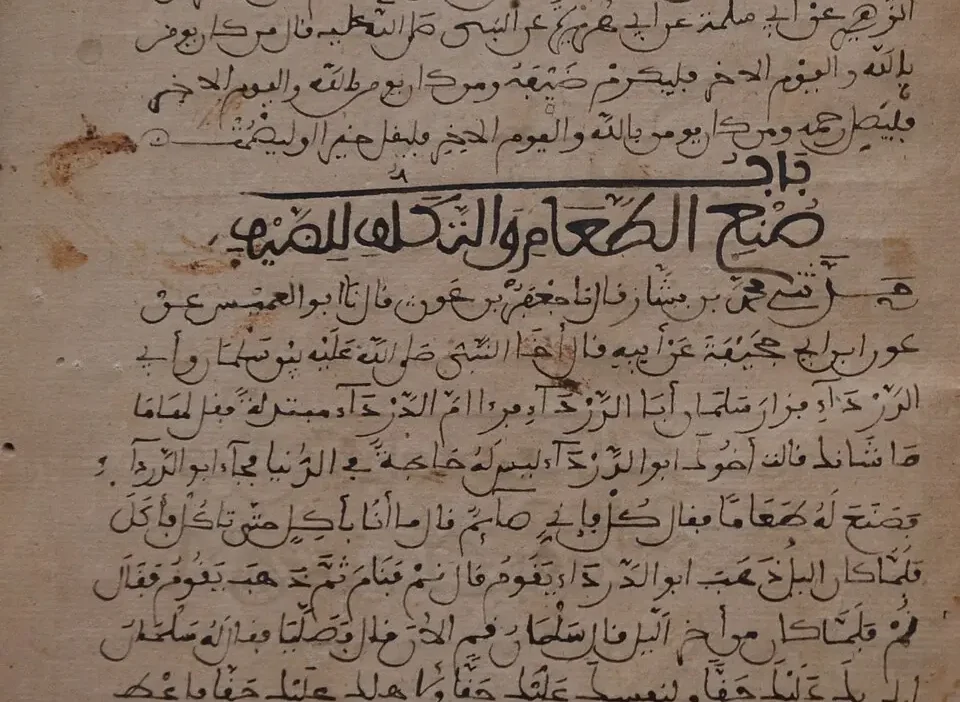
Image: Manuscript of Sahih al-Bukhari, written in Ramadan 490 AH (1097 CE) in Maghrebi script. Mohammed V University Library, Taroudant, Morocco. Public Domain via Wikimedia Commons.