
Introduction
In this article we examine the history of early Shīʿism during the ʿAbbāsid period. This covers the period from Jaʿfar al-Ṣādiq (d.765/148) to the death of the eleventh Imam Ḥasan al-ʿAskarī. Politically, this period covers the first half of the reign of the second caliph, Abū Jaʿfar al-Manṣūr to the first few years of the reign of al-Muʿtamid. This period witnessed the first ʿAbbāsid civil war, the move of the capital to Samarra and the subsequent ‘anarchy’ at Samarra. It also covers the deaths of the sixth to eleventh Imams (Jaʿfar al-Ṣādiq to Ḥasan al-ʿAskarī) and the deaths of the eponyms of the four Sunni madhhabs.
The ʿAbbāsid challenge
By claiming the Imamate based upon divine designation and upon descent from ʿAbbās, the ʿAbbāsids were in fact directly challenging the early Shīʿīs on their own ground. Although not everyone was happy with the outcome of the revolution, a number of groups were appeased. These included the mawālī (non-Arab converts) and the religious opponents of the Umayyads from both the early Shīʿī and Sunni sides, with some of the early Shīʿīs moving into the Sunni camp. The outcome of this was that the early Shia had to formulate and consolidate’ their beliefs in response to this new, almost existential threat. The main opposition to the ʿAbbāsid claim were the Kufan ʿAlids1. Among the early Shia who supported the ʿAbbāsids were the Kaysānī (followers of Abū Hāshim) and some of the Zaydīs.
The Imamate doctrine
It is in this period that we see the birth and development of the Imamate doctrine. The first known exposition of the Imamate doctrine was around 184/800 by ʿAlī ibn Mītham. He stated that ʿAlī was more deserving of the Caliphate than Abū Bakr and as such the Muslims were mistaken in giving precedence to Abū Bakr and ʿUmar over ʿAlī. However, he does not mention the existence of the Imams after ʿAlī. This is significant as it shows that at this stage, the early Shias were not agreed upon a particular line of Imams. Furthermore, in the presence of rival claims to leadership of the ʿAlids, many people were not necessarily committed to one claimant or the other.
Jaʿfar aṣ- Ṣādiq
Jaʿfar aṣ- Ṣādiq witnessed, but did not take part in the ʿAbbāsid revolution. He also lived through the anti-Umayyad revolts of Zayd ibn ʿAlī, ʿAbdullāh ibn Muʿāwiya as well as the anti-ʿAbbāsid revolt of Muḥammad al-Nafs al-Zakiyya. The revolt of Muḥammad al-Nafs al-Zakiyya in 145/762 in Madinah was supported by his brother Ibrāhīm who rebelled in Basra. However, both rebellions were quickly defeated.
Muḥammad al-Nafs az-Zakiyyawas, and still is, held in high esteem by both Sunnis and Shīʿīs, and among his thousands of students were the renowned Sunni scholars Abū Ḥanīfa and Mālik ibn Anas. He openly refuted some followers who held extreme beliefs, including a certain Abū ’l-Khaṭṭāb, who was executed in 138/755. Abū’l Khaṭṭāb attributed divinity to al-Ṣādiq. He also rejected common religious observances such as the prayer. Another follower of al-Ṣādiq was Hishām ibn al-Ḥakam, was repudiated by al-Ṣādiq for his ghuluww beliefs. These beliefs included attributing a three-dimensional body to God, claiming that God did not know about an event before its occurrence and that parts of the Qur’an had been distorted.
The descendants of Jaʿfar al-Ṣādiq
I will now briefly discuss those descendants of Jaʿfar al-Ṣādiq who were later to become known as the seventh to eleventh Imams by the Ithnā ʿAshariyya (the Twelvers).
The death of an Imam often led to disputes and factionalism regarding the identity of his true heir. Usually the argument was either that the deceased Imam had not really died but was in concealment, or raised to heaven to return back to fill the earth with justice, or that he had been succeeded by one of his descendants (although by whom was another area of contention). Some of the sub-sects held extreme beliefs such as the divinity of the Imam. The most significant of these splits occurred after the death of Jaʿfar al-Ṣādiq in 148 /765 during the reign of the second ʿAbbāsid caliph al-Manṣūr (r. 136–158 / 754–775). Approximately six splinter groups arose, eventually crystallising into two groups. The first group believed in the Imamate ended with his son Ismāʿīl (d. 158 /755), who would return as the Mahdī and were later to be known as the Ismāʿīlīs.
Mūsā al-Kāẓim
The second group were those who believed that the Imamate was transferred to his son Mūsā al-Kāẓim (d. 183/799)and were later known as the Ithnā ʿAshariyya. However this second group was one of many groups of known existence at the time, and it was not then considered to be normative. Mūsā al-Kāẓim lived during the reigns of al-Manṣūr, al-Mahdī and al-Rashīd, and it was during the reign of the latter that the persecution of the ʿAlids increased, although at the same time, the following of Mūsā amongst the ʿAlids increased.
ʿAlī al-Riḍā
Mūsā’s son, ʿAlī al-Riḍā (d. 203/ 818), lived during the civil war between al-Maʾmūn and al-Amīn. A number of early Shias used the unrest to launch their own uprising, capturing parts of the Hijaz, Yemen and Iraq. After Maʾmūn’s unexpected victory, he surprised both friend and foe by nominating ʿAlī al-Riḍā as his heir-apparent. He also announced, in opposition to the prevalent Sunni view, that ʿAlī was the best person after the Prophet. This caused a backlash amongst the ʿAbbāsids, whose very legitimacy to rule was based upon their claim that they were more entitled to rule than the ʿAlids, and in response they set up a rival claimant to the caliphate in Baghdad. The controversy was solved by the sudden, some say suspicious, death of ʿAlī al-Riḍā.
The Shia and many Muslim historians consider that he was poisoned. As for Maʾmūn’s motive for appointing an ʿAlid, there are a number of theories: it was to placate the various Shīʿī rebellions taking place at the time in Kufa, Makkah, Madinah, and Yemen; it was due to Maʾmūn’s personal Shīʿī convictions; or that he believed that the end of the world was close and he wanted to return to the ʿAlids that which was due to them. The modern day ʿAlawites are descended from the followers of Muḥammad ibn Nuṣayr an-Namīrī, who considered ʿAlī ibn Hādī to be God.
Muḥammad al-Taqī and ʿAlī al-Hādī
ʿAlī al-Riḍā’s son, Muḥammad al-Taqī (d.220 / 835), was only a child when his father died. Other than his marriage to al-Maʾmūn’s daughter, which could be seen as a corollary of al-Maʾmūn’s pro-ʿAlid policy, his life was apparently uneventful. His son ʿAlī al-Hādī (d.254 / 868) was also a child when his father died2. The ascension of al-Mutawakkil as caliph in 232/847 witnessed a persecution of both Shias and Muʿtazila.[23] Both ʿAlī al-Hādī and his son Ḥasan (d. 260 /874) were virtual prisoners of the caliphs in the army quarters of Samarra, and hence were called the two ‘Askarīs.
Ḥasan al-ʿAskarī (the eleventh Imam)
Ḥasan al-ʿAskarī lived during the anarchy at Samarra and the rise of the Turkish military. His death led to a period known as the ḥayra (confusion), as at the time of his death there was doubt as to whether he had left a male heir. The early Shia split into many sub-sects, with estimates ranging from between fourteen to twenty. Those who pledged allegiance to Ḥasan’s brother Jaʿfar insisted that Ḥasan had died childless, and formed one of the largest sub-sects. The group that was to prevail, however, believed that Ḥasan al-ʿAskarī had really died and left behind a son, Muhammad, who had gone into occultation.
Conclusion
What were the beliefs of the early Shia around the 880s (i.e. just after the death of the eleventh Imam)? Some scholars, such as the Muʿtazilī al-Kayyāṭ, and al-Ashʿarī who wrote shortly after the death of the eleventh Imam, state that the Shia held anthropomorphic views with respect to God, believed in badāʾ (alteration of God’s Will) and the alteration of the Qur’an. Badāʾ refers to a change in God’s will. This belief was first articulated by Mukhtār al-Thaqafī after his promised victory did not transpire. According to this belief, although God may decree a matter to occur at a particular moment, He may change his mind due to some expediency. Another example of the usage of this term is the argument of Ithnā ʿAshariyya that although Ismāʿīl was decreed to succeed his father Jaʿfar, his brother Mūsā actually succeeded him due to badāʾ.
However, the idea of the divinity of the Imams was not common at this stage in the view of al-Kayyāt and al-Ashʿarī. According to Momen, the beliefs of the early Shia at this stage was diametrically opposed to what was to be later known as Imāmī Ithnā ʿAshariyya Shīʿism. In addition, the concept of the ghayba (occultation) of the twelfth Imam, or fixing the number of Imams at twelve was, at this time, not universally accepted. The Shīʿī author Muḥammad al-Nuʿmānī (d.360/971) stated that many of the Shīʿī of his time ‘were uncertain as to the identity of the Imam and had doubts as to his occultation’.
Notes
- This explains why Abū Salama, who was the ‘Abbāsid representative in Kūfa, preferred an ‘Alid to be the future ‘Abbāsid Caliph. His plans were thwarted by the Khurāsāni Abū Muslim. ↩︎
- Which raised the problem of a non-pubescent Imām. ↩︎
References
Andrew J. Newman. Twelver Shīʿism Unity and Diversity in the Life of Islam, 632 to 1722 (2013)
Buhl, F., “Muḥammad ibn ʿAbd Allah ibn al-Ḥasan al-Muthannā ibn al-Ḥasan ibn ʿAlī ibn Abī Ṭālib, called al-Nafs al-Zakiyya”, in: Encyclopaedia of Islam, Second Edition
Christopher Melchert, Aḥmad Ibn Ḥanbal, (Oneworld Publications, 2012)
Goldziher, I. and Tritton, A.S., “Badāʾ”, in: Encyclopaedia of Islam, Second Edition
Halm, H, Shīʿism (Edinburgh University Press, 2004)
Jonathan Porter Berkey, The Formation of Islam: Religion and Society in the near East, 600-1800, (Cambridge University Press, 2003), p. 104.
Michael Cooperson al-Maʾmūn (Makers of the Muslim World) (2012)
Moojan Momen, An Introduction to Shīʿī Islam, The History and Doctrines of Twelver Shīʿism (1985)
W. Montgomery Watt. The Formative Period of Islamic Thought (1988)
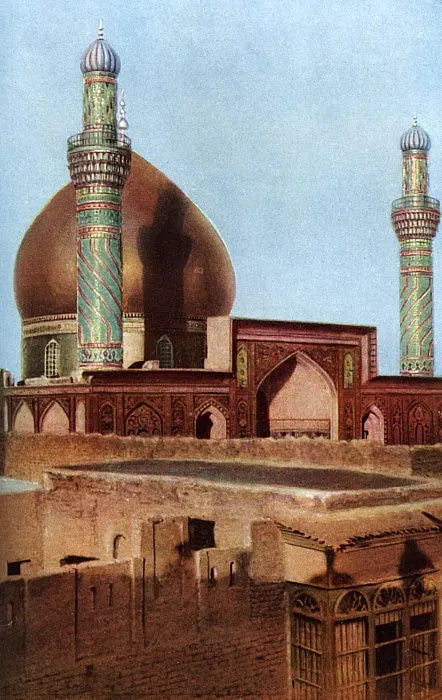
Image: Al-ʿAskarī Mosque Samarra, 1930s (Public Domain, Wikimedia Commons)
Other spellings of names in this article: ʿUmar (Umar, Omar); ʿAlī (Ali); Abū Bakr (Abu Bakr, Abu Bakar); Muʿāwiya (Muawiya, Muawiyah); Ḥasan (Hasan, Hassan); Khaṭṭāb (Khattab); Abī Ṭālib (Abi Talib); Shīʿī (Shia, Shi’a, Shiite); Shīʿism (Shiism, Shi’ism); Muʿtazila (Mutazila, Mutazilites); Ismāʿīlī (Ismaili); Zaydī (Zaydi, Zaidi); Ghadīr (Ghadir, Ghadeer); Mukhtār (Mukhtar).