
The collapse of the Ottoman Empire in the aftermath of the First World War remains one of the most contested episodes in modern Islamic history. For Muslims around the world, its dismemberment was a civilisational trauma. Yet the Ottoman Empire that fell in 1918 was not the unified caliphate of popular imagination.
Into this already turbulent history, the name of Abdulaziz Ibn Saʻūd has been inserted as a convenient villain. From 1902 onwards, Ibn Saʻūd set out to restore Saudi rule over the Arabian Peninsula, a project that coincided in time with both the First World War and the Ottoman collapse. Critics allege that he spearheaded the rebellion that brought down the Ottomans.
This article argues that the allegation is unsupported by the historical record on every material point. Ibn Saʻūd’s campaigns were directed not against the Ottomans but against the Rashidi dynasty of Ḥāʾil, his family’s local Arabian enemies, who had themselves begun as Saudi vassals before accepting Ottoman patronage. When the First World War broke out, Ibn Saʻūd repeatedly and unambiguously refused British requests to fight the Ottomans, and Ottoman sources confirm that he actively supplied Ottoman forces during the siege of Medina. The Arab Revolt of 1916, which is often conflated with Ibn Saʻūd’s campaigns, was a British-backed Hashemite bid for dynastic power that Ibn Saʻūd refused to join and which had at best a marginal role in the Ottoman defeat.
The Ottoman decline was centuries in the making and when the killing blow finally came, it was delivered not by Ibn Saʻūd but by an antireligious secular nationalist movement from within Ottoman ranks itself, whose fateful decision to enter the First World War on the side of Germany and Austro-Hungary was the direct cause of its destruction.
Fighting (Qitāl) and Rebellion (khurūj) Are Not the Same
Before examining the historical record, we will first establish what the charge of “rebellion” (Khurūj) actually means in Islamic jurisprudence, since the critics levelling it rarely define their terms. Khurūj is defined as any public opposition to the Muslim ruler, whether by speech, incitement, organisation, or arms.1 Qitāl simply means fighting. The two are not synonymous. A ruler who fights a neighbouring power, defends his territory, or resists the forces of a third party is engaged in qitāl, not khurūj.
The prohibition on khurūj established by the Sunnah and is affirmed by the consensus of the scholars. The Prophet ﷺ said: “Whoever sees something from his ruler that he hates, let him be patient. Whoever secedes from the community by as much as a handspan and dies will have died a death of ignorance.” 2 Imam al-Nawawi, commenting on the traditions of the chapter al-Imārah in Ṣaḥīḥ Muslim, states: “Rebellion (khurūj) and waging war against the rulers is ḥarām, for on this point there is a consensus (ijmāʿ) of the Muslim scholars, even if the ruler is corrupt or oppressive.”
Khurūj is committed against one’s own wālī al-amr, the ruler who holds authority over you. Ibn Saʻūd’s campaigns however were directed against the Rashidis, his family’s dynastic enemies in central Arabia. The Rashidis were not Ibn Saʻūd’s rulers. They were a rival Arabian dynasty that had expelled his family from Riyadh. Furthermore, Ibn Saʻūd’s entire military theatre was confined to the Arabian Peninsula. He launched no campaigns into Ottoman Syria, Iraq, or Anatolia, nor did he move against Ottoman forces beyond defending his own territory against Rashidi aggression. The historical record on this will be examined in what follows.
Before examining Ibn Saʻūd’s campaigns, it is necessary to understand the nature of the Ottoman state he is accused of undermining.
The Ottoman empire in the twentieth century – the rise of the CUP
The Ottoman caliphate effectively ended when a group of Western-educated army officers known as the Committee of Union and Progress (CUP) marched on Istanbul and deposed Sultan Abdülhamid II on 27 April 1909.3 Ottoman policy would henceforth be driven by the CUP, and following a further coup in January 1913, real power narrowed to a triumvirate of Enver, Cemal, and Talat.4
The CUP initially presented itself as Ottomanist – the idea that all subjects of the empire, Muslim or Christian, Turkish or Arab) shared a common identity regardless of ethnicity or religion. It would also use pan-Islamism, and Turkish nationalism as political tools depending on the audience.
What united the CUP’s leadership was a deep hostility to religion. According to the historian Hanioglu, the men who founded and led the CUP had a worldview that was “vehemently antireligious, viewing religion as the greatest obstacle to human progress.”5 Their ultimate goal was the transformation of Ottoman society into one in which religion played no role, with science replacing it entirely. Many of its founders were trained at the Royal Medical Academy in Istanbul, which Hanioglu describes as “a spawning ground for materialist and antireligious ideas,” and “where senior fellows required pious students to read Darwin to dislodge their faith.”6 Underpinning this antireligious outlook was a philosophical commitment to positivism – the belief that science, not religion, should govern society.7 Ahmed Rıza, its most prominent ideologue, illustrated his contempt for Islam in a private letter to his sister, lambasting Islamic gender laws and declaring that were he a woman he would embrace atheism outright.8 Publicly, and for pragmatic reasons, the CUP presented itself as defending Islam and the caliphate against European imperialism.
Once in power, the CUP moved to dismantle the Islamic institutional order. This included the subordination of sharīʿa courts to state control, and subjecting their decisions to review by secular appeals courts.9 Arabic and Islamic symbols were stripped from public life as the new regime replaced the traditional Islamic identity that had united Turks and Arabs with an explicit Turkish nationalism.10 Arab and Kurdish regions lost their local autonomy under a policy of aggressive centralisation, and the historic privileges of non-Turkish Muslim communities were cancelled.11
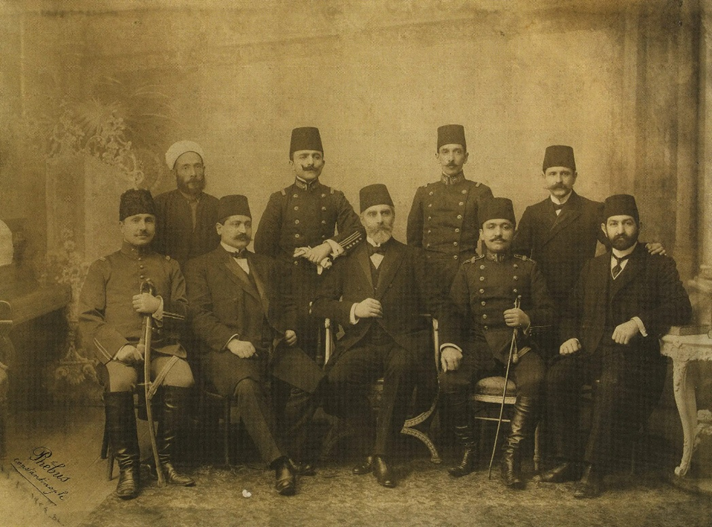
Members of the Central Committee of the CUP. Standing from left: Hafız İbrahim Efendi, Enver Pasha, Hüseyin Kadri Bey, Mithat Şükrü Bleda. Sitting from left: Habib Bey, Talaat Pasha, Ahmet Rıza Bey, Hafız Hakkı Pasha, Hayri Bey. c. 1908. Boghos Tarkulian, Public domain, via Wikimedia Commons
The CUP had strong ties to Freemasonry. Until 1902, Ottoman Freemasons had operated their own political organisations, distributing tracts on liberty across Europe, before throwing their weight behind the CUP.12 All but one of the founding members of the Ottoman Freedom Society in Salonika, which merged with the CUP in 1907, were Freemasons, belonging to either the Italian rite Macedonia Risorta or the French rite Véritas.13 The CUP conducted its secret meetings in Salonikan Masonic lodges. The Freemasons claimed to have been “the main force” behind the 1909 revolution, and the CUP consolidated this relationship by establishing its own lodge, Le Grand Orient Ottoman, in 1909 to reduce the power of foreign-affiliated lodges.14 The CUP simultaneously ran Islamist propaganda when it suited them, dispatching delegates to Mecca during the hajj season to court the ulema of the Muslim world. At the same time, the Turkish nationalist journals that they promoted placed the Turkish nation above the Arabs.15 A vocal opponent to the CUP was Derviş Vahdetî who headed the Committee of Muslim Unity. In his journal Volkan (Volcano), he described the CUP as an “an atheist, Masonic enterprise.”16
The movement also drew heavily on the Dönme, a secretive community of crypto-Jews descended from followers of the false messiah Sabbatai Zevi, who had converted to Islam in the seventeenth century while secretly maintaining Jewish practices. Concentrated in Salonika, the CUP’s birthplace, the Dönme joined the movement’s first branch there “en masse” when it opened in 1896.17 Neither Muslim nor Jewish, they were natural recruits to a movement whose real agenda was the replacement of religion with secular nationalism.18
Thus from 1909 onwards, Ottoman Empire was ruled by a secular leadership whose organisational infrastructure was built inside Masonic lodges. In October 1914, this leadership committed the empire to war alongside Germany and Austro-Hungary. This ill-thought decision resulted in millions of Muslim causalities, the loss of Arab provinces to Britain and France, the permanent colonisation of Palestine, and ultimately the loss of the sultanate itself.
We now turn to the late eighteenth century and the founding of the first Saudi state.
Mecca during Ottoman rule
Mecca and Madina were ruled by Sharifs whose Hashemites lineage afforded them a religious authority. Unlike other provinces within the Ottoman empire the Sharifs functioned as semi-independent rulers. Both cities, during Ottoman rule, had succumbed to corruption and innovation. Sufism, superstition and open sinning flourished and were protected by the Ottoman state. Regarding the Hajj caravans arriving from Syria and Egypt, Vassiliev records:
“The pilgrims were accompanied by musicians, playing tambourines, drums and other instruments. Many pilgrims brought alcohol with them and it was not unusual to find groups of prostitutes in the caravans. All this could not fail to provoke the Wahhabis’ hostility because of its incompatibility with their religious and moral standards.”19
Within Mecca itself, whole blocks belonged to prostitutes who even paid a tax on their earnings.20 The rest of Arabia fared no better. Throughout the peninsula, people worshipped domes, trees, rocks and even caves. Sorcery was widespread and very few people observed the obligatory prayers or paid zakat.
The first Saudi state (1744 – 1818)
Shaikh Ibn Abd al-Wahhab (d. 1792) was a reviver who re-introduced tawḥīd and the implementation of the Sharīʿah to the Arabian Peninsula. The first Saudi state emerged as a direct result of the alliance in 1745 between Shaikh Muhammad ibn Abd al-Wahhab and the tribal leader, Muhammad ibn Saʻūd. The map below shows the territories under Ottoman control in the late seventeenth century. Najd was never under Ottoman control, although the Hijaz of Western Arabia was an Ottoman vassal. Significantly, the First Saudi State was founded at Diriyah in Najd, a region that lay entirely outside Ottoman administration, meaning its origins and early consolidation were a matter of internal Arabian politics. It was only as the state expanded beyond Najd under Abd al-Aziz ibn Muhammad ibn Saʻūd (r. 1765–1803) into al-Hasa in the East, terminating the rule of Banu Khalid, and later into the Hijaz that it came into direct conflict with Ottoman-controlled territories. Notably, al-Hasa itself had not been under Ottoman control since 1670, when the Banu Khalid expelled them from the region.
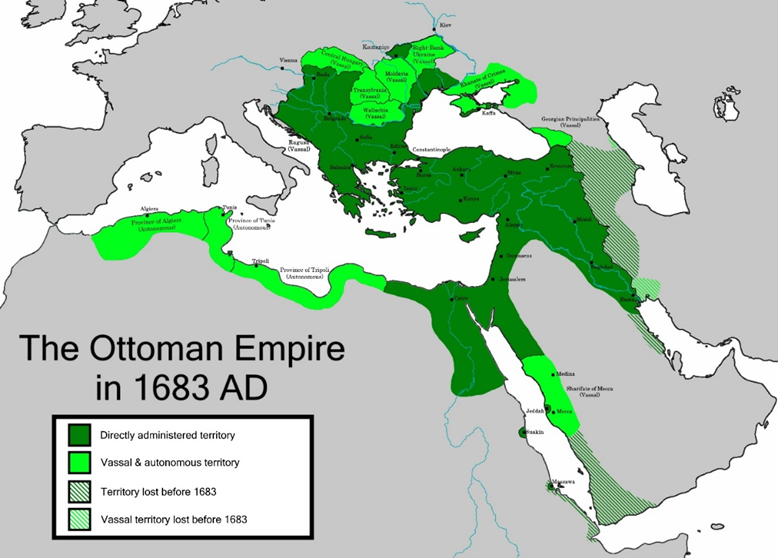
Chamboz at English Wikipedia, CC BY-SA 4.0 <https://creativecommons.org/licenses/by-sa/4.0>, via Wikimedia Commons
The conquest of Mecca
The dawah and expansion of the Saudi state alarmed Sharif Ghalib of Mecca. From 1790 onwards he waged repeated military campaigns against them and, fearful that Najdī pilgrims would spread their teachings among the ḥajj caravans, sought to prevent them from performing the pilgrimage. His efforts bore little fruit. Saʻūd ibn ʻAbd al-ʻAzīz successfully repulsed multiple attacks, and after Ghālib’s forces were defeated at Dhurma, the Saudi army entered Mecca in March 1803. Normal life in the city resumed the following day. Madina fell subsequently, in 1805, completing Saudi control over the Ḥijāz.21 Saʻūd ibn Abd al-Aziz wrote to the Ottoman Sultan Selim after the occupation of Mecca stating:
“I entered Mecca on the fourth day of Muharram in the 1218th year of the Hijra. I kept peace toward the inhabitants. I destroyed all the things that were idolatrously worshipped. I abolished all taxes except those that were required by the law. I confirmed the Qadi whom you had appointed, agreeably to the commands of the Prophet of Allah. I desire that you will give orders to the rulers of Damascus and Cairo not to come up to the sacred city with the Mahmal and with trumpet and drums. Religion is not profited by these things. May the peace and blessing of God be with you.”22
Ibn Saʻūd outlawed gambling, tobacco, prostitution and the playing of musical instruments. Bowen notes that as a result, “many less devout Muslims, who had viewed the hajj as more of a vacation than a time of religious purity, stayed away from the region.”23 Vassiliev adds that the Damascus pasha, to obtain a Hajj permit from the Wahhabis, had to “prohibit wine and strong beverages, urge the closure of all the Damascus markets during prayers and ban shaving of beards.”24 The loss of Mecca was a heavy blow to the prestige of the Ottoman Sultan. Their claim to be the protector of the two holy cities was the cornerstone of their religious authority across the Muslim world. The Saudi entry in Mecca and Madina shattered the Sultan’s symbolic status. Hence they decided to act against Ibn Saʻūd.
The map below shows the territory under the first Saudi state.
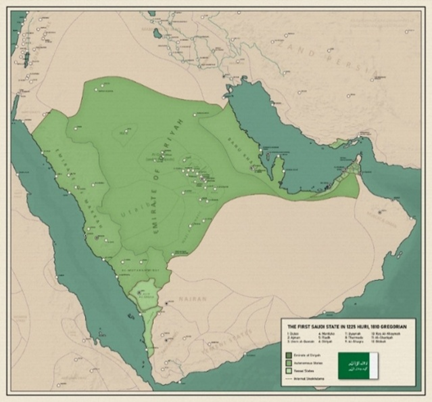
AbdurRahman AbdulMoneim, CC BY-SA 4.0 <https://creativecommons.org/licenses/by-sa/4.0>, via Wikimedia Commons
The end of the first Saudi state
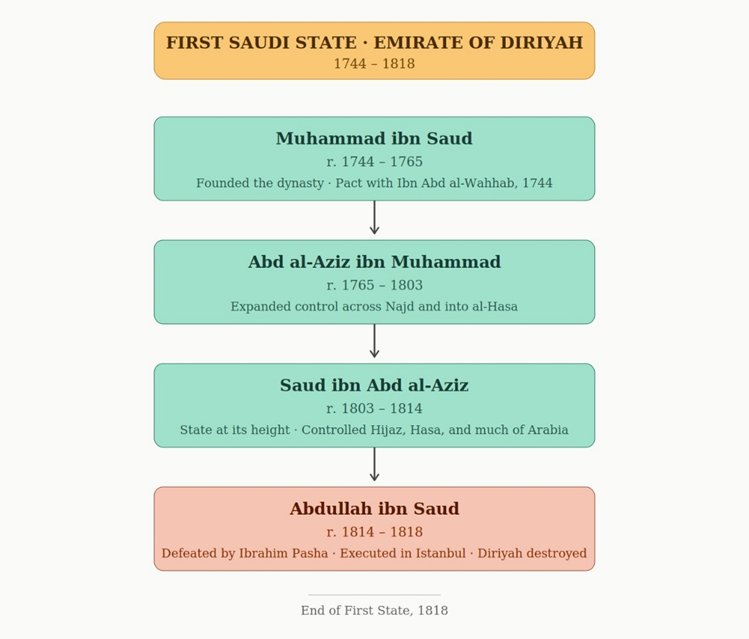
In 1811, the Ottoman Sultan Mahmud II (r. 1808–39) instructed his viceroy of Egypt, Muhammad Ali, to invade the Saudi state. Muhammad Ali sent his son Ibrahim Pasha, who after eight years of campaigning laid siege to the Saudi capital Diriyah.25 Among his forces were Albanians, Turks, Egyptians, and even European mercenaries who had served with Napoleon.26 After conquering Mecca and then Madina (where a Scottish mercenary, Thomas Keith, was appointed as acting governor) Muhammad ʿAlī launched a major offensive into the Najd.27 Equipped with modern French artillery, as well as French and Italian military advisers he besieged Diriyah. Under heavy artillery bombardment, the city fell after an eight-month siege. The capital was razed, numerous ʿulamāʾ were executed, and the Saudi ruler Abdullah bin Saʻūd was transported to Istanbul, paraded publicly in chains, and executed in 1819. Sulaiman ibn Abdallah, the grandson of Muhammad ibn Abd al-Wahhab, was executed after being forced to listen to the rabab (a single-stringed violin).28 Many other scholars were tortured to death.
The fall of Diriya in September 1818 marked the end of the first Saudi state. Under Ottoman rule, the region brought back music, alcohol and other forbidden forms of entertainment. The symbols of Islam such as the obligatory prayer and zakat were no longer enforced.
Muhammad Ali’s War against the Ottomans
After destroying the first Saudi state, Muhammad Ali rebelled against the Ottoman sultan and sent an army led by his son Ibrahim against the Ottomans in both Syria and Anatolia. Ibrahim’s forces came within 150 miles of Constantinople. Britain, Russia, Austria and Prussia intervened demanding he submit to Ottoman authority.29 The London Convention of 1840, forced Egypt to accept Ottoman suzerainty, thus staving off British and Russian military action against Ali’s forces. It was British and Russian intervention that saved the Ottomans from being overrun by a militarily superior Muslim power.30
The stance of the British
The British took a keen interest in the Ottoman-Egyptian war against first Saudi state. The British India government dispatched Captain George Forster Sadleir from Bombay to engage directly with Ibrāhīm Pasha, with instructions to coordinate and observe developments. Sadleir was directed to make arrangements with the Egyptian command “with a view to the complete reduction of the Wahhabi power,” and was further instructed to offer, “the aid of the British naval and military forces” in facilitating the campaign’s objectives.31
Why did Britain wish to see ‘Wahhabi’ forces destroyed? British authorities in India considered the southern Persian Gulf coast as their backyard. They wanted to monopolize trade routes between India and the Middle East and thus suppress any regional naval powers capable of challenging their dominance. However Britain’s dominance in the region was threatened by a maritime tribal confederation based along the southern Persian Gulf coast called the Qāsimīs.
The Qāsimīs had accepted the dawah of ibn Abdul Wahhab and formally submitted to Saudi authority, making them in British eyes an extension of the same threat. Goldberg notes that the Wahhabis were “suspected of instigating the piracies of the Qawasim” and of attempting to extend their influence toward Muscat.32 In 1810 the British had their first direct encounter with Wahhabi-backed forces at Shinas, storming a fort held by the Qāsimīs, after which they formally demanded the Saudi ruler restrain those under his authority. The piracy charge was thus a convenient legal pretext for a campaign to contain Saudi expansion along a coastline the British regarded as essential to their Indian trade routes. In 1819 the Royal Navy engaged in further expeditions culminating in the 1819 destruction of the main Qāsimī fleet and their fortifications.33
This dispels the myth that the ‘Wahhābi movement’ was in league with, or worse, a creation of British imperialists. The British actively opposed the ‘Wahhabi’ dawah.
The second Saudi state (1824- 1891)
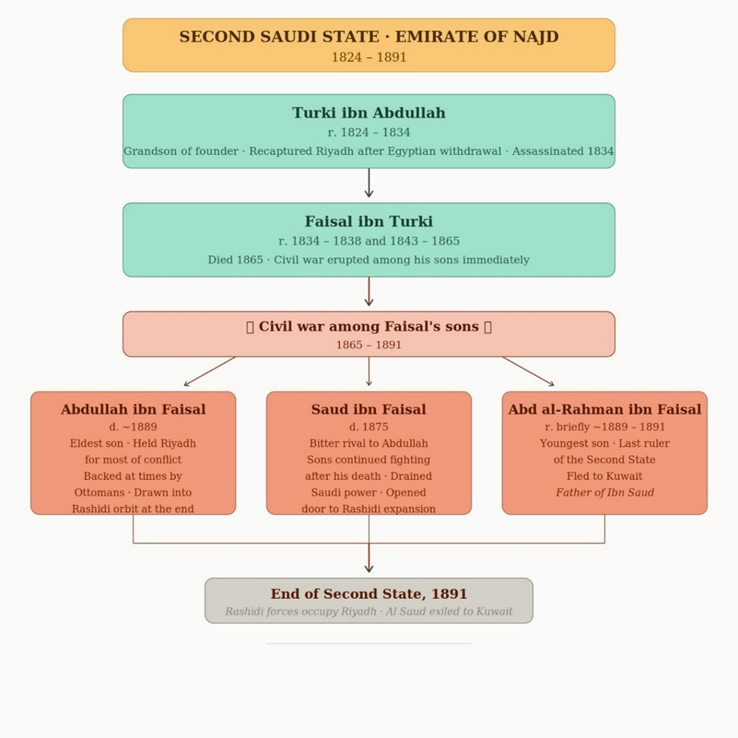
By 1820, the Egyptian army withdrew from Najd, burning trees and destroying food stores as they departed. With the Egyptian withdrawal, Turki ibn Abdullah captured Riyadh in 1824, founding the second Saudi state and making it the new capital in place of the razed Diriyah. By the end of Turki’s reign he had recaptured most the territories of the first Saudi state with the notable exception of Hijaz. He was assassinated by his cousin Mishari who then sought to seize power. This was thwarted by his son Faysal ibn Turki (r. 1834–38, then 1843–65) who sought the aid of Rashidi amir of Haʾil, Abdullah ibn Rashid.34
The Rashidi emirate in Hail
The Rashidis were the rulers of an area north of Najd known as the emirate of Haʾil which was established in 1836 a vassal of the second Saudi state. The first ruler of Haʾil was Abdullah bin Rashid who was appointed as its governor by Faysal bin Turki.35 Faysal bin Turki’s consolidation of the second Saudi state rested in part on this Rashidi cooperation who paid tribute in horses, pilgrim taxes, and spoils to Riyadh.36 The relationship between the Saʻūdis and the Rashidis would dominate Arabian power politics for the next eighty years, and it is this rivalry that lies at the heart of this article.
Faysal ibn Turki died 1865 appointing his son Abdullah ibn Faysal as leader. His half-brother Saʻūd ibn Faysal opposed him plunging the state into a decade of destructive civil war. Abdullah appealed to his father’s ally Muhammad Ibn Rashid of Haʾil for help. Muhammad ibn Rashid responded but not as expected. In 1891 he marched on Riyadh, expelled the rival claimants, but then imprisoned his former ally Abdullah. Abdullah’s brother, Abd al-Rahman ibn Faysal fled to Kuwait with his 15-year-old son Abdul Aziz (Ibn Saʻūd). He would later become the first king of Saudi Arabia. Thus ended the second Saudi state, this time due to internal conflict.
The Rashidi dynasty having ousted the Saudis, were now in control of central Arabia with Riyadh as its capital. They formed an alliance with the Ottoman Empire, recognizing the Ottoman sultan as ruler, in exchange for weapons and diplomatic support.37 In 1900 Abd al-Aziz ibn Rashid, with Ottoman support, attacked Kuwait planning to annex it. A second attack in 1901 culminated in the massacre of hundreds of civilians. Britain, an ally of Kuwait, intervened and convinced the Ottomans to stop prevent any further attacks.
What was the nature of this alliance between the Rashidis and Ottomans? Drawing on Ottoman, British, German, and Austrian archival sources, M. Talha Çiçek has shown that the Ottomans, after two failed attempts to establish direct administrative control over Najd, “established a partnership with the Rashidis, providing them with generous support and helping them against any local threats to their rule.”38 Ottoman experience in the region led them to understand “the difficulty of using coercive measures to control the Bedouins in Najd,” compelling them instead “to cooperate with local power-holders.”39 Najd was never integrated into the Ottoman central administration. The Rashidis commanded their own armies, collected their own revenue, and exercised their own internal authority. The Ottoman provided subsidies and weapons but did not govern them. This distinction is decisive. When Ibn Saʻūd returned from exile in 1902 and moved against the Rashidis, he was not challenging an Ottoman province. He was challenging an Ottoman client, one that had betrayed its original Saudi rulers. He goal was to recover territory lost to a local enemy in an intra-Arabian contest. The Ottoman dimension cannot be ignored but it was secondary.
The third Saudi state
Abdul Aziz Ibn Saʻūd, living in exile in Kuwait, was determined to restore the land captured from his ancestors. In January 1902, with a group of 50 men, he launched a daring surprise attack on Riyadh, capturing the city and killing the Rashidi governor. This marked the beginning of the third Saudi state which was to outlive both the Ottoman and British Empires. Using Riyadh as his base, he set out to reconquer Arabia and defeat the Rashidis. By 1904 Ibn Saʻūd had captured large swathes of the Najd region causing Ibn Rashid to appeal to the Ottomans for military support. The Ottomans sent troops and ammunition to support their Rashidi clients but were ultimately defeated by Ibn Saʻūd, and they returned to Basra and Madina. In 1906 Ibn Saʻūd captured Qasim killing Abd al-ʿAzīz ibn Mitʿab ibn Rashid. The Ottomans decided to a negotiate a settlement with Ibn Saʻūd. They withdrew to Hijaz and accepted Ibn Saʻūd’s rule over Najd.
In 1913 Saudi forces seized Hasa, a province the Ottomans had previously taken from the Saudis in 1871 and nominally controlled ever since. Ibn Saʻūd offered the garrison safe passage and camels for the evacuation. In May 1914, the Saudis and Ottomans concluded a treaty that accepted Saudi control of the region, but preserved nominal Ottoman sovereignty.40 The treaty recognised Ibn Saʻūd as Wālī and commander-in-chief of Najd,41 but simultaneously forbade him from entering into relations with foreign powers (i.e. Britain).42 Within months, that prohibition would be tested by the outbreak of the First World War.
British – Ottoman relations prior to World War One
In the years leading up to the outbreak of the First World War, both the Ottomans and the British maintained friendly relations and were keen not to antagonise each other over Arabia. In 1901 they agreed to support a balance of power among the Arabian peninsula’s competing local rulers rather than allow any single power to dominate. Britain’s main strategic interests were the coastal rulers of the eastern peninsula, Kuwait, Bahrain, Qatar, and the Trucial states (modern day UAE) while for the Ottomans the Hijaz and Yemen were the core concerns. Basra, despite being under Ottoman control, was the main port for the East India Company. This relationship was solidified by 1838 Anglo-Ottoman Commercial Treaty with Britain.43 Goldberg documents that the British government maintained “a policy of strict non-intervention in the affairs of central Arabia” and issued instructions “to abstain from any connection with Ibn Saʻūd.”44
The Anglo-Ottoman Convention of 1913 drew a line across the Arabian Peninsula creating British and Ottoman spheres of influence in eastern and southern Arabia. British dominance in Kuwait and the Gulf was officially recognised by the Ottomans. In return. Britain recognised that territories under Ibn Saʻūd’s control were in fact the “Ottoman district of Najd.45 This convention illustrates the extent to which late Ottoman policy in Arabia (and elsewhere) was governed by a pragmatic attitude to the geopolitics of the region rather than a utopian pan-Islamic ideology. The Ottoman state was content to grant Britain formal dominance over Muslim-majority territories along the Arabian coast in exchange for diplomatic recognition of their own claims elsewhere.
The second Anglo-Ottoman Convention of March 1914 explicitly restated British recognition of Ottoman sovereignty over Najd and Hasa, and the Foreign Office continued to insist that relations with Ibn Saʻūd must not jeopardise the broader relationship with Istanbul.46
Both empires were playing the same game, managing local Arabian power-brokers to serve their own wider strategic interests while carefully avoiding direct confrontation with each other. Ibn Saʻūd understood this, and engaged in statecraft accordingly. playing the available political options as any ruler of a contested territory would.
Dialogue between Ibn Saʻūd and the Ottomans
By 1912 the Ottoman Empire was under severe pressure on multiple fronts. It had just lost Libya to Italy and was about to suffer catastrophic defeats in the Balkans. There was unrest in Yemen, Asir, and Syria during 1910–11 in response to Ottoman centralisation. Among Arab officers and educated elites there were calls for decentralisation and administrative autonomy for Arabs within the Ottoman Empire.47
The CUP government reached out to Ibn Saʻūd. His power base in Najd lay on the borders of these restless provinces, was seen as a potential lever. The Ottomans had come to regard him as a significant factor in desert politics and, as Iqbal records, “sought to bring him into their counsels as a makeweight against the nationalist movement in the settled lands on his borders.”48 But Ibn Saʻūd’s response went considerably further than they had anticipated. He told Sulaiman Shafiq Pasha, the governor of Basra, that the Turks:
“should convene a meeting of all the chiefs, great and small without distinction, at some place not actually under Ottoman administration, so that there might be absolute freedom of speech. The general object of the meeting would be the establishment of harmony in the Arab lands, and friendship between them and the Ottoman Government; and their specific task would be a choice between two alternatives. Either the Arab countries should form a single group presided over by a ruler of their own choice; or the existing arrangement of separate political entities should continue on the basis of complete local administrative independence, each under its own rules functioning as a Wali in a Turkish province.”49
The second proposal was framed around the preservation of Ottoman suzerainty, the aim being, as Iqbal observes, “to make the Ottoman-Arab unity something real.”50 The Ottomans rejected them outright. The proposals “were in direct conflict with the policy of the Young Turks,” whose centralising programme left no room for formal Arab autonomy.51 By ignoring Ibn Saʻūd’s proposals, the Ottomans committed what Iqbal calls “a political mistake”, they “lost chances of winning the Arab cooperation when it was needed most” i.e. the First World War.52
The rejection of Ibn Saʻūd’s proposal reflected a Turkish nationalist ideology the CUP had held since before it came to power. Dr. Nazım, one of its most senior figures, had stated explicitly that the organisation’s aim was “centralisation and a Turkish monopoly on power… a unified Turkish nation-state with Turkish schools, a Turkish administration, and a Turkish legal system”. He resolved that the empire would never become “a new Austria-Hungary” of autonomous nationalities. 53 Ibn Saʻūd’s proposals were incompatible with that programme.
Saudi – British relations during World War One
Although Ibn Saʻūd’s long-term goal remained the same, the unification of Arabia under his rule, he now had to factor in the competing imperial interests now encircling Arabia. His Rashidi enemies had, prior to the outbreak of war, aligned themselves with the Ottomans. The British on the other had shown scant interest in Ibn Saʻūd except where his activities might threaten their control over the coastal Gulf regions. Now things had changed. Britain was now looking for allies in Najd as a counterweight to Ottoman authority. Ibn Saʻūd also knew that his long-term strategic goal to unify Arabia could not ignore the British, who were a major Gulf power.
The Anglo-Saudi Treaty, signed in December 1915 by Ibn Saʻūd and Sir Percy Cox, formalised this new relationship. Under its terms, Britain acknowledged that “Najd, El Hassa, Qatif and Jubail, and their dependencies and territories are the countries of Ibn Saʻūd,” and pledged to protect these territories from external aggression. In return, Ibn Saʻūd agreed to “refrain from entering into any correspondence, agreement, or treaty with any foreign nation or Power,” to grant no concessions to foreigners without British approval, and not to alienate any part of his territory without British consent. He further pledged not to intervene in the affairs of Kuwait, Bahrain, Qatar, and the Trucial Coast. On signing, Ibn Saʻūd received 1,000 rifles and £20,000, and was subsequently granted a monthly subsidy of £5,000.54 Crucially however, the treaty did not require Ibn Saʻūd to fight the Ottomans.
The Ottomans also tried to elicit Ibn Saʻūd’s support during the war. He refused to support either side, but promised not to hinder caravans travelling from Syria via Najd to ‘Asir and Yemen supplying the Turkish army with food.55
Ibn Saʻūd refused to fight the Ottomans
As the war progressed, Britain repeatedly asked Ibn Saʻūd for military assistance against the Ottomans, but he consistently refused. On 3 November 1914, Major Knox formally invited Ibn Saʻūd to cooperate with Mubarak of Kuwait in “the liberation of Basra from the Ottomans.” Ibn Saʻūd was also asked to prevent Ottoman reinforcements from reaching Basra. In return the British offered protection, recognition of his independence, and a treaty. Ibn Saʻūd’s response on 28 November 1914 offered no practical assistance, describing himself as “a person who desired to remain quiet and in repose so that my state may not become impaired.”56
In January 1915, Percy Cox (Chief Political Officer for the British Indian Army’s Expeditionary Force in Mesopotamia) then sent Captain Shakespeare to bring Ibn Saʻūd “north to help suppress hostile activities by the tribes between Basra and Baghdad.”57 At the three-day meeting, Shakespeare’s own report to the Foreign Office made it “abundantly clear that Ibn Saʻūd’s refusal to commit to a military role against the Ottomans was totally unconditional.”58
Alois Musil (a Czech historian with Ottoman contacts operating in Arabia during the war) reported that in early summer 1916 Ibn Saʻūd established direct communication with Turkish forces at Medina and supplied them with camels. He also sent a delegation to Damascus in September 1916.59 Macfie, argues that Ibn Saʻūd’s assistance to the besieged Ottoman garrison in Madina, was a decisive factor in securing their survival.60
Ottoman sources acknowledge this. In his memoirs, Jemal Pasha, commander of the Ottoman Armies in Palestine, Sinai and Syria, contrasted the sharif’s treacherous and ‘double-faced role’ during the war with Ibn Saʻūd’s positive attitude, revealing that Ibn Saʻūd ‘made himself very useful to us by sending camels to the army from the far depth of Nejd,’ and concluding that ‘Ibn Saʻūd could not give us any direct assistance as he was too near the English.’ 61
Throughout World War One, Saudi – Rashidi hostilities continued unabated. Their conflict was primarily an internal Arabian dynastic conflict independent of British or Ottoman strategic interests. However, with the outbreak of the war, their rivalry intersected with the British- Ottoman conflict. Ibn Saʻūd’s relationship with the British was essentially transactional, and pragmatic. He needed their weapons to fight his region rivals, the Rashidis who happened to be allied with the Ottomans. The latter entered an existing conflict, and on more than one occasion, Ibn Saʻūd defended himself against Ottoman aggression.
The Arab revolt
The contrast with Sharif Husayn’s Arab Revolt makes Ibn Saʻūd’s refusal all the more significant. Sharif Husayn ibn Ali, Emir of Mecca, had been a loyal Ottoman official since his appointment in 1908. Yet his relationship with Istanbul deteriorated sharply in the years before the war.
Yet as Ottoman centralisation following the Young Turk revolution of 1908–09 eroded Arab autonomy, his relationship with Istanbul deteriorated sharply. The outbreak of the war and the rising Arab discontent with the CUP provided the perfect opportunity for Sharif Hussein to make his bid for power. His goal was to replace Ottoman rule with a Hashemite dynastic empire.
In 1915 Husayn opened secret negotiations with the British High Commissioner in Egypt, Sir Henry McMahon. This resulted in a military alliance in which Britain pledged support for an Arab state, including the Arabian Peninsula, Iraq and Syria, in exchange for a Hashemite revolt against the Ottomans.
Britain’s wartime treaty with Sharif Husayn was thus fundamentally different from the Anglo-Saʻūdi Treaty of December 1915. The former was explicitly conditional on his declaring war and launching the Arab Revolt against the Ottomans. The Anglo-Saʻūdi Treaty on the other hand contained no reference whatsoever to a Saʻūdi military contribution to the British war effort.62
The terms of the agreement were deliberately ambiguous by the British, leaving the exact territorial boundaries unresolved.63 On 10 June 1916, Husayn raised the flag of revolt in Mecca, and declared war on the Ottomans.64 A few months later, much to the annoyance of the British, he declared himself the King of the Arab Lands. Most of the Arabic-speaking population in the Ottoman Empire did not support the Arab revolt. It was largely confined to specific Hijazi Bedouin tribes who were heavily incentivized by British gold (almost £1m), heavy weapons and food supplies.65
David Murphy estimates that the campaign tied down between 20,000 and 30,000 Ottoman troops in Arabia.66 The Revolt disrupted the Hejaz Railway, and prevented Ottoman redeployment to Palestine. Although was a real military contribution to the Allied cause, it wasn’t the main factor in the Ottoman defeat. They lost primarily because of their catastrophic decision to enter on the German side in 1914, the successful Allied campaigns in Iraq and Palestine, and decades of internal structural decay. Ultimately when Germany collapsed, the Ottomans collapsed with it.
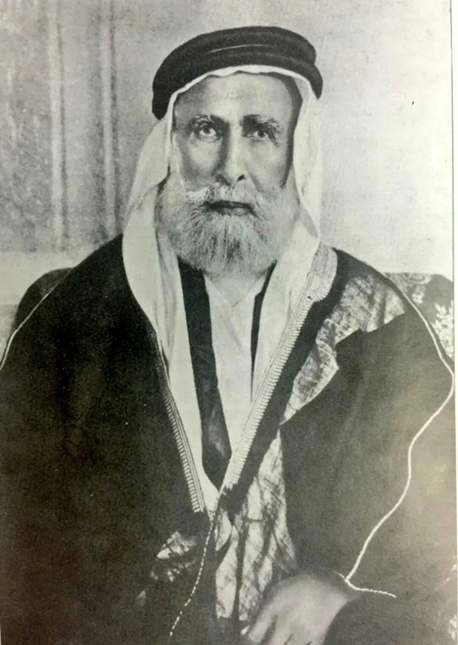
Sharif Husayn, who declared a military uprising against the Ottoman Empire from the Arabian Desert on June 10, 1916. Picture taken I916 or before, since the image accompanied his published proclamation in 1916. Unknown author www.arabianheritagesource.com/altehomepage/page150.html.
Did the British supply Ibn Saʻūd with weapons?
Unlike Sharif Husayn, who received British weapons in exchange for open war against the Ottomans, Ibn Saʻūd received rifles and a subsidy under a treaty that required him to fight no one. The answer to whether Britain supplied him with weapons is clearly yes, and in light of what has been discussed, it is not problematic. Only someone with a simplistic understanding of Islamic political thought and the realities of international relations, would raise it as a concern. Classical Muslim jurists recognised that rulers were responsible for preserving the security and interests of the Muslim community and could enter treaties, alliances, truces, and diplomatic arrangements whenever circumstances required. Throughout history Muslim states frequently cooperated with non-Muslim powers against rival Muslim states, sought military assistance from non-Muslims when facing existential threats. Ibn Saʻūd was no exception to this nor were the Ottomans. The latter, whose sovereignty Ibn Saʻūd is accused of undermining, had a long record of soliciting European military and diplomatic intervention, even against fellow Muslims, whenever its survival demanded it. A few examples are given below.
Sultan Selim I’s conquest of the Mamluk Sultanate in 1516–17 was an offensive war of territorial expansion against a fellow Sunni Muslim power. The Mamluks had governed Egypt, Syria, and the holy cities for over two centuries.67 Selim’s justification, that the Mamluks had supported the “heretic” Shah Ismaʿil, was a pretext whose weakness contemporaries recognised. As the Cambridge History of Turkey notes, “scholar officials called upon to legitimise the Ottoman conquest in religious terms were in a delicate position,” and it remains impossible to know how many accepted Selim’s reasoning.68 The conquest was driven by imperial ambition: control of Egypt, Syria, and the trade routes of the Red Sea and Indian Ocean.
Ibn Saʻūd’s campaigns, by contrast, were directed against a local Arabian dynasty that had betrayed his own family, and he took the Hijaz in 1924-5 only after the Ottoman Empire had already ceased to exist. A century earlier when Saʻūd ibn Abd al-Aziz entered Mecca in 1803, he wrote personally to the Ottoman Sultan to account for his actions, that he had destroyed objects of shirk, abolished unlawful taxes, and confirmed the Ottoman-appointed qadi in his post.1 The primary motivation was the restoration of tawhid, not the seizure of power.
The Ottomans relied on the support of non-Muslims during their conflict with Mohammad Ali Pasha of Egypt, an Ottoman governor in Egypt who sent his forces into Ottoman territories in Syria threatening the central authority in Istanbul. Unable to stop him, the Ottomans turned to Russia for military assistance. Russian troops were deployed to the Bosphorus, and the crisis was resolved by the Convention of Kütahya (1833), which granted Mohammad Ali control of Syria. Shortly after, the Ottomans signed the Treaty of Hünkâr İskelesi with Russia in July 1833, a defensive alliance promising Russian military assistance against any future threat to Istanbul. 69 When Mohammad Ali invaded again in 1839, the Ottoman army was destroyed at the Battle of Nezib. Britain, Austria, Prussia and Russia intervened collectively under the Convention of London 1840, forcing Mohammad Ali to withdraw to Egypt. In both episodes the Ottomans sought and accepted non-Muslim military intervention to preserve their state. 70
This pattern continued into later crises. During the Crimean War (1853–1856), the Ottoman state entered a formal military alliance with Britain and France against the Russian Empire, with British and French forces directly participating in the defence of Ottoman territorial integrity. In return, the Ottomans pursued reforms contrary to the Shariah including legal equality for non-Muslim subjects.71
During the 1877–78 Russo-Ottoman War, Russian forces swept through the Balkans and almost captured Constantinople. The British sent a fleet of warships to keep the Russians out of Istanbul.72 This support came at a heavy cost; under the Cyprus Convention of June 1878, the Ottomans ceded administrative control of Cyprus to Britain as the condition for a British defensive commitment to Ottoman territories in Asia.73
Following their defeat in the 1912-13 Balkans war, the Ottomans were at risk of being carved up completely by Russia or Austria. They turned to a number of European powers to guarantee their survival. However, on this occasion, Britain Austria-Hungary, Russia, Germany and France, all turned them down. 74
In the Anglo-Ottoman Convention of 1914, discussed previously, the Ottoman recognised Britain’s role as protector of Kuwait, Qatar and Bahrain, whereas previously they had held this was an infringement on Ottoman sovereignty along the Arabian coastline.75
The Ottoman Empire, in short, destroyed a Sunni sultanate, and accepted non-Muslim military intervention and territorial concessions as a matter of geopolitical necessity. The charge against Ibn Saʻūd for accepting British weapons thus applies with equal, if not greater, force to the very empire in whose name it is made.
Did Ibn Saʻūd Serve British Imperial Interests?
A critic might concede that although Ibn Saʻūd did not actively fight the Ottomans, he still served British imperial interests: that his neutrality, his non-interference in the Gulf, and his suppression of the Rashidis effectively cleared the way for British dominance in Arabia. This argument collapses under scrutiny on two grounds.
First, the interior of the Arabian Peninsula was of no strategic interest to Britain before the discovery of oil in the 1930s. As Goldberg records, central Arabia “had nothing to offer to the mercantile and industrial world,” its population did not exceed three million, and apart from the holy cities of Mecca and Medina “only the port town of Jidda and the small ports along the gulf coast were of any importance.”76 British strategic interest was confined to the coast: Kuwait, Bahrain, Qatar, and the Trucial States, where it sought to protect the sea route to India. Najd, where Ibn Saʻūd’s power was based, lay entirely outside this zone of concern. As late as 1907, the Secretary of State for India formally reiterated that British interests “should be confined to the coast” and that no steps should be taken to enter into relations with Ibn Saʻūd without prior sanction.77
Second, when Britain did finally conclude a treaty with Ibn Saʻūd in December 1915, it contained no requirement that Ibn Saʻūd fight anyone. By mid-1917 he had effectively disengaged from the British war effort in protest at London’s preference for Sharif Husayn, and the British were alarmed enough that they sent Philby to Riyadh to re-engage him. Iqbal records that Ibn Saʻūd “decided in disgust to reverse the benevolent attitude hitherto maintained by him” and “withdrew his attention from the War.”78
Post World-war One
With the Ottoman collapse in 1918, the political landscape of Arabia was transformed. The victorious Allies, redrew the map of the Middle East and the Ottoman empire now ceased to exist. Shariff Hussain’s ambition of ruling over all Arabs was shattered. The former Ottoman Arab territories were divided between the British and French. He was allowed to keep Hijaz.
Within the Arabian Peninsula, Ibn Saʻūd marched into ‘Asir (south of Hijaz) whose Idrisi rulers had supported the British against the Ottomans, and then conquered the Rashidi capital Ha’il in 1921.79 In March 1924, the Ottoman caliphate was formally abolished and in response, Shariff Hussain declared himself to the caliph. Ibn Saʻūd’s forces entered Mecca in October 1924. Madina surrendered on 5 December 1925, followed by Jeddah on 21 December. On 8 January 1926, Ibn Saʻūd was proclaimed King of the Hijaz and Sultan of Najd.80 He now ruled over all four main regions of Arabia; Najd, Hasa, Hijza, and ‘Asir, and this was formally recognised by Britain, the USSR, France, and the Netherlands. Shariff Hussain was escorted to Cyprus by the British. He died in 1931 in Jordan.
Conclusion
The allegation that Ibn Saʻūd rebelled against the Ottomans and contributed to their downfall is not supported by the historical evidence. Three conclusions emerge clearly from the evidence examined above.
First, Ibn Saʻūd’s campaigns were directed primarily against the Rashidis, the dynasty that had expelled his family from Riyadh in 1891 and subsequently served as an Ottoman client in central Arabia. When Ibn Saʻūd returned from exile in 1902 and moved to reclaim Najd, he was re-engaging an intra-Arabian conflict that had its roots decades before the First World War. Ottoman troops intervened on the Rashidi side, but the conflict itself was never, at its core, a Saudi rebellion against Istanbul.
Second, during the First World War itself, the period when the Ottoman collapse actually occurred, Ibn Saʻūd refused to fight the Ottomans. He rejected repeated British requests for military assistance. He supplied the besieged Ottoman garrison at Madina with camels. His relationship with Britain was transactional: weapons and recognition in exchange for neutrality and non-interference in the Gulf. The Anglo-Saudi Treaty of 1915 contained no requirement that he fight anyone. Jemal Pasha’s own memoirs are the most telling evidence, an Ottoman commander contrasting Ibn Saʻūd favourably with Sharif Husayn.
Third, the Ottoman Empire had been losing territory, sovereignty, and fiscal independence for centuries before its final collapse. The decisive blow was the CUP’s catastrophic decision to enter the First World War on the German side. The Arab Revolt, British-bankrolled and Hashemite-led, tied down perhaps 20,000 to 30,000 Ottoman troops in the Hijaz, a real but marginal contribution to a war which was ultimately decided in the trenches of Europe. Ibn Saʻūd played no part in the Revolt at all.
Attributing the Ottoman collapse to Ibn Saʻūd is not a historical argument. It is a polemical one, driven by opposition to the dawah of Muhammad ibn Abd al-Wahhab and pursued without regard for the evidence. The Ottomans who fell in 1918 were not undone by a Najdi chieftain they never controlled. They were undone by secular nationalists from within their own ranks, who gambled an empire on the wrong side of a world war and lost.
Bibliography
Books
Anderson, Betty S. A History of the Modern Middle East: Rulers, Rebels, and Rogues. Stanford: Stanford University Press, 2016.
Baer, Marc David. The Dönme: Jewish Converts, Muslim Revolutionaries, and Secular Turks. Stanford: Stanford University Press, 2010.
Bowen, Wayne H. The History of Saudi Arabia. Westport, CT: Greenwood Press, 2008.
Faroqhi, Suraiya, and Kate Fleet, eds. The Cambridge History of Turkey, vol. 2, The Ottoman Empire as a World Power, 1453–1603. Cambridge: Cambridge University Press, 2013.
Goldberg, Jacob. The Foreign Policy of Saudi Arabia: The Formative Years, 1902–1918. Cambridge, MA: Harvard University Press, 1986.
Hanioğlu, M. Şükrü. A Brief History of the Late Ottoman Empire. Princeton: Princeton University Press, 2008.
———. Preparation for a Revolution: The Young Turks, 1902–1908. Oxford: Oxford University Press, 2001.
———. The Young Turks in Opposition. Oxford: Oxford University Press, 1995.
Iqbal, Sheikh Mohammad. Emergence of Saudi Arabia: A Political Study of King Abd al-Aziz ibn Saud, 1901–1953. Barzalla Bridge: Saudiyah Publishers, 1977.
Kasaba, Reşat, ed. Turkey in the Modern World, vol. 4 of The Cambridge History of Turkey. Cambridge: Cambridge University Press, 2008.
Kelly, J. B. Britain and the Persian Gulf, 1795–1880. London: George Allen & Unwin, 1968.
Macfie, A. L. The End of the Ottoman Empire, 1908–1923. London: Longman, 1998.
Murphy, David. The Arab Revolt 1916–18: Lawrence Sets Arabia Ablaze. Oxford: Osprey Publishing, 2008.
Onley, James. The Arabian Frontier of the British Raj. Oxford: Oxford University Press, 2007.
al-Rasheed, Madawi. A History of Saudi Arabia. Cambridge: Cambridge University Press, 2002.
Shaw, Stanford J., and Ezel Kural Shaw. History of the Ottoman Empire and Modern Turkey, vol. 2, Reform, Revolution, and Republic: The Rise of Modern Turkey, 1808–1975. Cambridge: Cambridge University Press, 1977.
Troeller, Gary. The Birth of Saudi Arabia: Britain and the Rise of the House of Saud. London: Frank Cass, 1976.
Vassiliev, Alexei. The History of Saudi Arabia. London: Saqi Books, 2000.
Wynbrandt, James. A Brief History of Saudi Arabia. New York: Facts On File, 2004.
Zürcher, Erik J. Turkey: A Modern History. 4th ed. London: I.B. Tauris, 2017.
Journal Articles
Çiçek, M. Talha. “The Tribal Partners of Empire in Arabia: The Ottomans and the Rashidis of Najd, 1880–1918.” New Perspectives on Turkey, no. 56 (2017): 101–126.
Goldberg, Jacob. “The Origins of British–Saudi Relations: The 1915 Anglo–Saudi Treaty Revisited.” The Historical Journal 28, no. 3 (1985): 693–703.
Karsh, Efraim, and Inari Karsh. “Myth in the Desert, or Not the Great Arab Revolt.” Middle Eastern Studies 33, no. 2 (April 1997): 267–312.
Sirriyeh, Elizabeth. “Wahhabis, Unbelievers and the Problems of Exclusivism.” Bulletin of the British Society for Middle Eastern Studies 16, no. 2 (1989): 123–132.
- Shaykh Uthaymeen said, “There is no Khurūj with the sword except that it is preceded by Khurūj with the tongue” Quoted by Shaikh Abdullaah Al-Bukhaari in ‘Sharh Fadl Ilm As-Salaf Alaa Ilm Al Khalaf- Audio Number 1. Questions & Answers section↩︎
- Ṣaḥīḥ al-Bukhārī 7054, Ṣaḥīḥ Muslim 1849↩︎
- Its formal abolition came later in 1924.↩︎
- Enver Pasha served as Minister of War, Talat Pasha as Minister of the Interior (and later Grand Vizier from 1917), and Cemal Pasha as Minister of the Navy and de facto ruler of Syria. Together they effectively controlled Ottoman policy after the 1913 coup until exile following the empire’s defeat in 1918↩︎
- M. Şükrü Hanioglu, Preparation for a Revolution: The Young Turks, 1902–1908 (Oxford: Oxford University Press, 2001), p. 305-6.↩︎
- M. Şükrü Hanioglu, The Young Turks in Opposition (Oxford: Oxford University Press, 1995), p. 20.↩︎
- Aswell as positivism they subscribed to biological materialism (man is pure matter with no soul) and social darwinism (nations compete like species; only the fittest survive)↩︎
- M. Şükrü Hanioglu, The Young Turks in Opposition (Oxford: Oxford University Press, 1995), p. 201.↩︎
- M. Şükrü Hanioglu, Preparation for a Revolution: The Young Turks, 1902–1908 (Oxford: Oxford University Press, 2001), p. 308.↩︎
- Reşat Kasaba, ed., Turkey in the Modern World, vol. 4 of The Cambridge History of Turkey (Cambridge: Cambridge University Press, 2008), 83↩︎
- ibid↩︎
- Marc David Baer, The Dönme: Jewish Converts, Muslim Revolutionaries, and Secular Turks (Stanford: Stanford University Press, 2010), p. 93. Macedonia Risorta, headed by the CUP leader Emmanuel Carasso, housed the organisation’s archives and counted the majority of the Salonikan branch’s leadership among its members↩︎
- ibid↩︎
- Ibid. 94↩︎
- M. Şükrü Hanioglu, Preparation for a Revolution: The Young Turks, 1902–1908 (Oxford: Oxford University Press, 2001), p. 71↩︎
- Marc David Baer, The Dönme: Jewish Converts, Muslim Revolutionaries, and Secular Turks (Stanford: Stanford University Press, 2010), p. 106. Derviş Vahdetî was a Cypriot-born Ottoman Islamist journalist and founder of the newspaper Volkan, which became a major platform for opposition to the CUP. He played a leading role in mobilising Islamic resistance against the CUP before being executed in 1909. The Committee of Muslim Unity, which he led, aimed to replace the Constitution with the Sharia, replace secular schools and courts with Islamic equivalents, and restore sultanic authority.↩︎
- Marc David Baer, The Dönme: Jewish Converts, Muslim Revolutionaries, and Secular Turks (Stanford: Stanford University Press, 2010), p. 85; Salonika is now called Thessaloniki.↩︎
- Ibid., p. 112.↩︎
- Vassiliev, Alexei. The History of Saudi Arabia. London: Saqi Books, 2000. P 105↩︎
- Vassiliev, Alexei. The History of Saudi Arabia. London: Saqi Books, 2000. P 138↩︎
- Sheikh Mohammad Iqbal, Emergence of Saudi Arabia: A Political Study of King Abd al-Aziz ibn Saud, 1901–1953 (Barzalla Bridge: Saudiyah Publishers, 1977),↩︎
- Jacob Goldberg, The Foreign Policy of Saudi Arabia: The Formative Years (Cambridge, MA: Harvard University Press, 1986), 11–12. A mahmal was a ceremonial, empty palanquin or litter mounted on a camel that was considered holy, and sent with the Hajj caravan, especially from Cairo and Damascus. It was richly decorated and functioned as a symbol of the ruler’s authority.↩︎
- Bowen, Wayne H. The History of Saudi Arabia. Westport, CT: Greenwood Press, 2008, pp. 95–96.↩︎
- Vassiliev, Alexei. 105↩︎
- Elizabeth Sirriyeh, “Wahhabis, Unbelievers and the Problems of Exclusivism,” Bulletin (British Society for Middle Eastern Studies) 16, no. 2 (1989): 123–132↩︎
- Bowen, Wayne H. The History of Saudi Arabia. Westport, CT: Greenwood Press, 2008. 74↩︎
- Ibid, 75↩︎
- F. Mengin, Histoire, vol. 2, p. 136; Ibn Bishr, Unwan, part 1, pp. 202, 210, 212–213. Cited in Vassiliev, Alexei. 158↩︎
- Bowen, Wayne H. The History of Saudi Arabia. Westport, CT: Greenwood Press, 2008. 78↩︎
- Bowen argues the Europeans “preferred the weak and decadent Ottoman Empire, in which they had significant investments and leverage, to a reformed, ambitious, and modernizing Egypt.” Ibid.↩︎
- Goldberg, Jacob. The Foreign Policy of Saudi Arabia: The Formative Years, 1902–1918. Cambridge, MA, and London: Harvard University Press, 1986. 17 citing J. A. Saldanha, Précis of Correspondence Regarding the Affairs of the Persian Gulf, 1801-1853 (Calcutta, 1906), p. 93.↩︎
- Goldberg, Foreign Policy of Saudi Arabia, 13–14.↩︎
- James Onley, The Arabian Frontier of the British Raj (Oxford: Oxford University Press, 2007), 28–65; J. B. Kelly, Britain and the Persian Gulf, 1795–1880 (London: George Allen & Unwin, 1968), 122–240;↩︎
- Faysal ibn Turki also had to contend with the British in the Eastern Arabian coast in 1845 and 1846, when he demanded tribute from Bahrain. In 1850 the Royal Navy came to Bahrain’s defence and Faisal was forced to make peace. Wynbrandt, James. A Brief History of Saudi Arabia. New York: Facts On File, 2004. 13↩︎
- Wynbrandt, James. A Brief History of Saudi Arabia. New York: Facts On File, 2004. 159↩︎
- Vassiliev, Alexei. The History of Saudi Arabia. London: Saqi Books, 2000. 196↩︎
- Ibid. 80↩︎
- M. Talha Çiçek, “The Tribal Partners of Empire in Arabia: The Ottomans and the Rashidis of Najd, 1880–1918,” New Perspectives on Turkey, no. 56 (2017): 107. Çiçek explains that the Ottoman aim was to secure their regional interests; the stability of Syria, the Hijaz, Iraq, and the Persian Gulf through Rashidi control of central Arabia.↩︎
- Ibid. 111. The Ottomans twice tried to extend direct administration into Najd through Midhat Pasha (Baghdad) and Abdullatif Subhi Pasha (Syria) and both efforts failed. This experience taught the Ottomans that coercive administration in Najd was not viable..↩︎
- Bowen, Wayne H. The History of Saudi Arabia. Westport, CT: Greenwood Press, 2008. 87↩︎
- Jacob Goldberg, The Foreign Policy of Saudi Arabia: The Formative Years, 1902–1918 (Cambridge, MA: Harvard University Press, 1986), pp. 106–107↩︎
- Madawi al-Rasheed, A History of Saudi Arabia (Cambridge: Cambridge University Press, 2002), 41↩︎
- Bowen, Wayne H. The History of Saudi Arabia. Westport, CT: Greenwood Press, 2008. 68↩︎
- Jacob Goldberg, “The Origins of British–Saudi Relations: The 1915 Anglo–Saudi Treaty Revisited,” The Historical Journal 28, no. 3 (1985): 693–703.↩︎
- Gary Troeller, The Birth of Saudi Arabia: Britain and the Rise of the House of Saud (London: Frank Cass, 1976), 52–53; Goldberg, “Origins of British–Saudi Relations,” 696.↩︎
- Goldberg, “Origins of British–Saudi Relations,” 697, citing Gooch and Temperley, British Documents on the Origins of the War, vol. X, pt. II, pp. 340–1.↩︎
- Betty S. Anderson, A History of the Modern Middle East: Rulers, Rebels, and Rogues (Stanford: Stanford University Press, 2016) 183-4. Explicit demands for independence were rare.↩︎
- Sheikh Mohammad Iqbal, Emergence of Saudi Arabia (Srinagar: Saudiyah Publishers, 1977), 58↩︎
- Alexei Vassiliev, The History of Saudi Arabia (London: Saqi Books, 2000).226↩︎
- Iqbal, Emergence of Saudi Arabia 59↩︎
- Alexei Vassiliev, The History of Saudi Arabia (London: Saqi Books, 2000), 226↩︎
- Iqbal, Emergence of Saudi Arabia. 60↩︎
- M. Şükrü Hanioglu, Preparation for a Revolution: The Young Turks, 1902–1908 (Oxford: Oxford University Press, 2001), 261↩︎
- Madawi al-Rasheed, A History of Saudi Arabia (Cambridge: Cambridge University Press, 2002), 42. Ibn Saud’s subsidy from the British was moderate compared to the £200,000 monthly subsidy Shariff Husain was receiving.↩︎
- Vassiliev, Alexei. The History of Saudi Arabia. London: Saqi Books, 2000. 236↩︎
- Goldberg, Jacob. The Foreign Policy of Saudi Arabia: The Formative Years, 1902–1918. Stanford: Harvard University Press, 1986, pp. 116–117, citing F.O. 371/2140 and F.O. 371/2479, pp. 305a, 292.Goldberg, Jacob. “The Origins of British–Saudi Relations: The 1915 Anglo–Saudi Treaty Revisited.” The Historical Journal 28, no. 3 (1985): 699, fn. 22, citing F.O. 371/2140.↩︎
- Goldberg, Jacob. The Foreign Policy of Saudi Arabia: The Formative Years, 1902–1918. Cambridge, MA: Harvard University Press, 1986, p. 117, fn. 11, citing L/P&S/10/387, pp. 141–142 and Philip Graves, The Life of Sir Percy Cox (London, 1941), p. 182; Captain William Shakespear was a British explorer, geographer, and political officer who served as the British Political Agent in Kuwait.↩︎
- Goldberg, Jacob. “The Origins of British–Saudi Relations: The 1915 Anglo–Saudi Treaty Revisited.” The Historical Journal 28, no. 3 (1985): 699, fn. 24, citing F.O. 371/2479, p. 338.↩︎
- Goldberg, Jacob. The Foreign Policy of Saudi Arabia: The Formative Years, 1902–1918. Cambridge, MA: Harvard University Press, 1986, p. 149, fn. 28, citing Alois Musil, Northern Nejd (New York, 1928), pp. 288–289.↩︎
- A. L. Macfie, The End of the Ottoman Empire, 1908–1923 (London: Longman, 1998), 148-49↩︎
- Djemal Pasha. Memories of a Turkish Statesman, 1913–1919. London: Hutchinson, 1922, pp. 152, 165, cited in Goldberg, Jacob. The Foreign Policy of Saudi Arabia: The Formative Years, 1902–1918. Cambridge, MA: Harvard University Press, 1986, p. 150, fn. 29.↩︎
- Goldberg, Jacob. “The Origins of British–Saudi Relations: The 1915 Anglo–Saudi Treaty Revisited.” The Historical Journal 28, no. 3 (1985): 702, fn. 32, citing L/P&S/10/635, p. 79.↩︎
- Around the same time, Britain and France met secretly to divide up the post-Ottoman Arab world in what became known as the Sykes-Picot Agreement. Britain would take Iraq, Kuwait and Jordan, whereas Syria Lebanon and southern Turkey would go to France. The fate of Palestine would be determined in light of Zionist ambitions. This agreement contradicted the promises made by the British to Shariff Hussein.↩︎
- David Murphy, The Arab Revolt 1916–18: Lawrence sets Arabia ablaze, Campaign 202 (Oxford: Osprey Publishing, 2008), p. 8–9.↩︎
- Karsh, Efraim, and Inari Karsh. “Myth in the Desert, or Not the Great Arab Revolt.” Middle Eastern Studies 33, no. 2 (April 1997): 267–312.↩︎
- David Murphy, The Arab Revolt 1916–18: Lawrence sets Arabia ablaze, Campaign 202 (Oxford: Osprey Publishing, 2008), p. 23↩︎
- The Mamluk Sultanate (1250–1517) was a Muslim empire that ruled Egypt, Syria, and the holy cities of Mecca and Medina for over two and a half centuries. Founded by freed slave-soldiers, it became the most formidable military power in the medieval Islamic world. It was the Mamluks who halted the Mongol advance at the Battle of Ayn Jalut in 1260, the first decisive defeat of the Mongols in open battle, ending their westward expansion into the Islamic heartlands. They also expelled the last Crusader presence from the Levant, taking Acre in 1291 and bringing to an end two centuries of Crusader occupation of Muslim lands. As Faroqhi notes, by the time of Selim’s conquest they “had been the only rulers capable of keeping the Mongol armies at bay.” Suraiya N. Faroqhi, “Introduction,” in Suraiya N. Faroqhi and Kate Fleet, eds., The Cambridge History of Turkey, vol. 2, The Ottoman Empire as a World Power, 1453-1603 (Cambridge: Cambridge University Press, 2013), 10.↩︎
- Faroqhi, Suraiya, and Kate Fleet, eds. The Cambridge History of Turkey, Vol. 2: The Ottoman Empire as a World Power, 1453–1603. Cambridge: Cambridge University Press, 2013.↩︎
- M. Şükrü Hanioğlu, A Brief History of the Late Ottoman Empire (Princeton: Princeton University Press, 2008), 66–67.↩︎
- The Cambridge History of Turkey, vol. 4, Turkey in the Modern World, ed. Reşat Kasaba (Cambridge: Cambridge University Press, 2008), 13.↩︎
- M. Şükrü Hanioğlu, A Brief History of the Late Ottoman Empire (Princeton: Princeton University Press, 2008), 68–72.↩︎
- Stanford J. Shaw and Ezel Kural Shaw, History of the Ottoman Empire and Modern Turkey, vol. 2, Reform, Revolution, and Republic: The Rise of Modern Turkey, 1808–1975 (Cambridge: Cambridge University Press, 1977), 184↩︎
- Ibid, 190↩︎
- Suraiya Faroqhi, ed., The Cambridge History of Turkey, vol. 4, Turkey in the Modern World (Cambridge: Cambridge University Press, 2008), 90.↩︎
- Suraiya Faroqhi, ed., The Cambridge History of Turkey, vol. 4, Turkey in the Modern World (Cambridge: Cambridge University Press, 2008), 91↩︎
- Jacob Goldberg, The Foreign Policy of Saudi Arabia: The Formative Years, 1902–1918 (Cambridge, MA: Harvard University Press, 1986), p. 45.↩︎
- Gary Troeller, The Birth of Saudi Arabia: Britain and the Rise of the House of Saud (London: Frank Cass, 1976), p. 25, citing Secretary of State for India John Morley to Government of India, November 1906 and May 1907.↩︎
- Sheikh Mohammad Iqbal, Emergence of Saudi Arabia: A Political Study of King Abd al-Aziz ibn Saud, 1901–1953 (Barzalla Bridge: Saudiyah Publishers, 1977), p. 98↩︎
- Troeller, Gary. The Birth of Saudi Arabia: Britain and the Rise of the House of Saʿud. London: Frank Cass, 1976, p. 183, n. 1.↩︎
- Troeller, The Birth of Saudi Arabia, p. 231↩︎