
1. Introduction
This article discusses the compilation of the Qur’an in the time of the Prophet (sallahu alaihi wa sallam)Abu Bakr and Uthmaan, and highlights their differences the methodologies and outcomes.
a) Definition of the Qur’an
Muslim scholars define the Qur’an as the speech of Allah, uncreated, revealed by Allah to the Prophet Muhummad (sallahu alaihi wa sallam) via the angel Jibraeel. Its is inimitable, and its very recitation is an act of worship.
b) The Orientalists view
Contrary to the conjecture of the Orientalists, Muslims believe that there were three important stages in the compilation of the Qur’anic text; that in the time of the Prophet (sallahu alaihi wa sallam), followed by the compilations of Abu Bakr, and then Uthmaan.
Watt claims that the Qur’an was first compiled in the time of Uthmaan, however, due to the unpopularity of Uthmaan, scholars had to invent the account of Abu Bakr’s compilation. This was done to avoid giving credit to the work of Uthmaan. However, Watt provides no evidence as to who fabricated the story of Abu Bakr’s compilation and when the fabrication took place. History also disproves Watt’s theory. The Ummayads, who were Uthmaan’s descendants, came into power shortly after Uthmaan’s death and ruled for more than a century. Also Watt accepts that Uthmaan borrowed the mushaaf from Hafsa – thus contradicting his assertion that the first compilation took place in the time of Uthmaan.
2. The compilation of the Qur’an in the time of the Prophet (sallahu alaihi wa sallam)
a) Revelation and memorisation
The Prophet (sallahu alaihi wa sallam) received the Qur’an from Allah in regular intervals throughout his 23-year mission. Sometimes he would receive an entire surah, other times a couple of verses. As soon as he received revelation, he would immediately teach it to his Companions.
The revelation of a complete surah, particularly the longer surahs, was sometimes over a period of time. A part of a surah would be revealed at one time, and another part, at a much later time. For example Surah Anaam is a Makkan surah, yet some of its verses were revelled in Madinah.
The Prophet (sallahu alaihi wa sallam) would commit to memory all the verses and surahs that were revealed to him. The task was made easy for him by Allah: “Move not your tongue in haste with it. Verily upon Us is its collection and recitation. So when We recite it, follow its recitation” (75:16-18).
Having memorised the verses of the Qur’an, the Prophet (sallahu alaihi wa sallam) would then teach the verses to his Companions, many of whom would also commit it to memory. A number of different methods were used by the Prophet to help and encourage the Companions to memorise the Qur’an:
b) Methods to aid memorisation
i) Recitation aloud in the prayer.
The Companions would hear the Qur’an daily. For example, he (sallahu alaihi wa sallam) used to recite al Sajdah and al-Insaan in the Fajr prayer, and al-Jumu’ah and al-Munafiqun in the Friday prayer (Bukhari). Some Companions memorised surahs by merely listening to the Prophet’s recitation.
ii) Muslims who were new to the faith were taught the Qur’an by other Companions.
For example, the Prophet (sallahu alaihi wa sallam) sent the Qur’an-teacher Mus’ab ibn Umayr to Madina (prior to the Hijrah) to preach Islam. Also, Ubaadah ibn as-Saamit mentioned that whenever someone migrated to Madinah, the Prophet (sallahu alaihi wa sallam) would allocate a Companion to teach him Qur’an. Eventually the masjid became very noisy because of the number of people reciting Qur’an. The seventy Companions were treacherously killed in their mission to Bi’r Ma’unah were all Qurraa. This shows that a large number of Companions had memorised the Qur’an.
iii) Encouraging the learning and teaching of the Qur’an.
The Prophet (sallahu alaihi wa sallam) said; “The best of you are those who learn the Qur’an and teach it”. He also taught that reading just one letter from the Qur’an meant the recitor would gain ten rewards. The Prophet (sallahu alaihi wa sallam) also cautioned against forgetting verses of the Qur’an.
Thus, before the death of the Prophet (sallahu alaihi wa sallam), many Companions had memorised the entire Qur’an, while others had memorised a great deal of it.
c) Writing the Qur’an
Simultaneous with the memorisation of the Qur’an, the verses and surahs were written down as soon as they were revealed. According to Ibn Saad, the Prophet (sallahu alaihi wa sallam) had 24 scribes for the purpose of writing the revelation. The most prominent scribes were; Ibn Masood, Zaid ibn Thabbit, Ubay ibn Ka’ab, Mu’ad ibn Jabal, and Abu Darda. The writing material included palm stalks, thin white stones, scapula bones, leather, pieces of cloth and parachment. Paper was not used until much later, when the Muslims learnt the art from the Chinese.
An example of the Prophet (sallahu alaihi wa sallam) dictating the revelation is the following narration in Bukhari: “When it was revealed: ‘Not equal are the believers who sit at home and those that strive in the cause of Allah’ the Prophet said: ‘Call Zaid ibn Thabitt for me and tell him to bring the inkpot and scapula bone’. When Zaid came, the Prophet told him: ‘Write: Not equal are the believers who sit at home and those that strive in the cause of Allah’.
d) Arrangement of the verses
The scribes duty was not merely writing the Qur’an. Whenever a verse was revealed, the Prophet (sallahu alaihi wa sallam) would arrange it in the relevant place in the Qur’an. Likewise, the Prophet would arrange the order of the surahs The Qur’an was not complied chronologically but according to an arrangement and order fixed by Allah. Jibraeel would come to the Prophet (sallahu alaihi wa sallam) and tell him to place a particular verse in a particular place. Thus both the order of the Surahs within the Qur’an, and the orders of the verses within the Surahs was fixed.
Muslim narrates that Zayd ibn Thabbit said: “When we were with the Prophet, compiling the Qur’an from parchments….” This shows that the Prophet (sallahu alaihi wa sallam) was supervising the compilation and arrangement of verses. Tirmidhi also narrates that Zayd ibn Thabbit said: “We would compile the Qur’an in the presence of the Prophet”.
In addition Zayd, after receiving the dictation from the Prophet (sallahu alaihi wa sallam) would be commanded by the Prophet (sallahu alaihi wa sallam) : ‘read it (back to me)’
3. Rebuting an orientalist claim
The Orientalist, Noldleke claims that verses of the Qur’an were arbitrarily compiled into Surahs by Zayd b. Thaabit (after the death of the Prophet), as were the order of the Surahs. He claims that the Prophet did not arrange the verses into Surahs, nor the order of the Surahs within the Quran. This claim is easily refuted.
Firstly, we have shown that the Prophet (sallahu alaihi wa sallam) would instruct the scribes where to place the revelation. The scribes were informed whether the revelation consisted of one independent Surah (as was often the case when smaller and medium length surahs were revealed), or part of a surah. If it was the latter, they would be informed which pieces belonged to which surah, and the order in which they were to be placed.
Suyootee said: ‘the recitation of the Prophet (sallahu alaihi wa sallam) in front of the gatherings of the Companions proves that the arrangements of the verses is from him, and the Companions could not change the order of the verses from what the Prophet (sallahu alaihi wa sallam) recited. Therefore, the knowledge of the order of the verses in mutawaatir’ (al-Itqaan).
Secondly, there a number of reports mentioning that the Prophet (sallahu alaihi wa sallam) would recite particular surahs at certain times (Eid, Jum’uah, Fajr, etc). Hence the surahs were known and recognised by the Companions, and were not complied arbitrarily by Zayd.
Imaam al Karmaanee said: ‘The arrangement of the surahs is from Allah, and the Qur’an is written in the Lauh al Mahfoodh in this arrangement.’
Third, the Prophet (sallahu alaihi wa sallam) mentioned the special merits of reciting some surahs (al-Baqarah, Al-Imraan, Faatihah, al-Kahf, and many others). The very fact that al-Faatihah is called the opening of the Book proves that the Prophet (sallahu alaihi wa sallam) had arranged the order of the Surahs of the Qur’an.
4. The outcome of the Prophet’s compilation
Thus before the death of the Prophet (sallahu alaihi wa sallam) the Qur’an had been memorised by many of the Companions, and had been preserved in writing. The companions knew the order of verses within each surah, and the order of surahs within the Qur’an. Jibraeel would visit the Prophet (sallahu alaihi wa sallam) every Ramadan and recite the Qur’an to him whilst the Prophet listened. The Prophet would in turn recite the Qur’an back to Jibraeel. During the Prophet’s final Ramadan, Jibraeel recited the Qur’an to the Prophet (sallahu alaihi wa sallam) twice. This final reading was witnessed by Zayd ibn Thabitt.
The revelation was not collected in one book before the death of the Prophet as verses were being revealed right up to nine days before his death (sallahu alaihi wa sallam). Given that the verses were not placed in chronological order, the Qur’an could not be compiled into one book until all of the verses were revealed. This meant that the compilation of the Surahs of the Qur’an in one book could only take place when the revelation had stopped – i.e. the after death of the Prophet (sallahu alaihi wa sallam).
5. Challenges facing Abu Bakr
The Caliph Abu Bakr, upon assuming leadership of the ummah, faced a number of important challenges. The most serious was the wars of apostasy against the non payers of zakat, the hypocrites and the false prophets. The brunt of the battles were borne by many of the prominent Companions. During the battle of Yamaamah, Abu Hudayfah inspired and encouraged the Companions by saying: “O possessors of the Qur’an, decorate the Qur’an with deeds”. The Companions also encouraged one another by saying: “O companions of Surah al-Baqarah” (Ya as-haab suratul al Baqarah).
6. The martyrs of Yamaamah
In the battle of Yamaamah, 70 companions who had memorised the Qur’an were killed. The death of such a large number of qurra’a alarmed Umar. He went to Abu Bakr, expressing his fear that more qurra’a may be killed in subsequent battles. This may lead to a loss of the Qur’an, unless it was complied in one book. Initially Abu Bakr was reluctant to do something that the Prophet (sallahu alaihi wa sallam) had not done. But Umar convinced him that collecting the Qur’an was of benefit to the Muslims. The Prophet arranged for the Qur’an to be written in order to preserve it. By compiling it in one book was completing what the Prophet (sallahu alaihi wa sallam) had already started.
7. Zayd ibn Thaabit chosen to compile the Qur’an
Zayd ibn Thaabit was chosen to compile the Qur’an for the following reasons:
- he was one of the best recitors of the Qur’an, and had the most knowledge with regards to the recitation of the Qur’an.
- he had memorised the Qur’an
- he was a primary scribe of the Prophet
- he witnessed Jibraeel’s final recitation to the Prophet in Ramadan
- he was youthful and had a sharp memory
- he was of good morals
8. Zayd’s methodology of verification
Zayd was instructed: ‘Sit at the entrance of the masjid. If anyone brings you a verse of the Book of Allah, along with two witnesses, write it down’. (Ibn Abi Dawood). Ibn Hajar explained that for written material to be accepted by Zayd, two witnesses had to swear that it had been written in the presence of the Prophet (sallahu alaihi wa sallam). Any written material that the Companions may have privately copied from another Companion was not accepted. Zayd’s knowledge of the Qur’an (through memorisation and writing) could only be compared with material of the same standing.
Zayd also compared the written material presented to him against the memories of the Companions. ‘So I gathered the Qur’an from various parchments and pieces of bone, and the chests of men”. He then mentions that ‘I found the last two ayahs of Surah al-Bara’a with Abu Khuzaima al Ansari’ (Bukhari). These two ayat were written in the mushuf solely based on Abu Khuzaima al Ansari’s written form. However, other companions had memorised it and testified that it was from the Qur’an. Even though Zayd and his fellow companions had memorised the last two ayahs of Surah al-Bara’a, and could recall them perfectly, he was not authorised to record it in the mushuf, until he came across it in written form. This fact is in contrast to the conjecture of Noldelke who stated that Zayd collected the revelation “chiefly from the breasts of men”.
9. The outcome of Abu Bakr’s compilation
Thus by relying on written material, backed by witnesses, comparing the written material against the memories of other Companions, and his own memory, Zayd ensured that the Mus-huf that he compiled was indeed the same Book that Allah had revealed to His Messenger, and had promised to preserve. For this first time, the entire Qur’an was in one Book. This compilation accommodated the various dialects of the Arabs. After the death of Abu Bakr, the Mus-huf was passed on to Umar, then to Hafsah after the death of Umar.
Further reading
The History of the Quranic Text, from Revelation to Compilation: A Comparative Study with the Old and New Testaments by Muhammad Mustafa Al-Azami.
Ulum al Qur’an: An Introduction to the Sciences of the Qur’an by Ahmad Von Denffer.
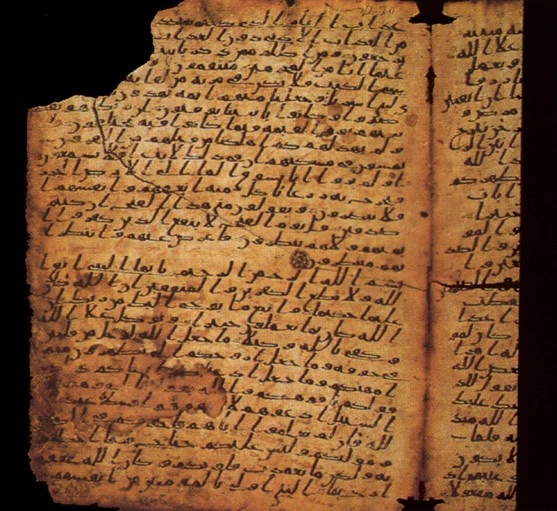
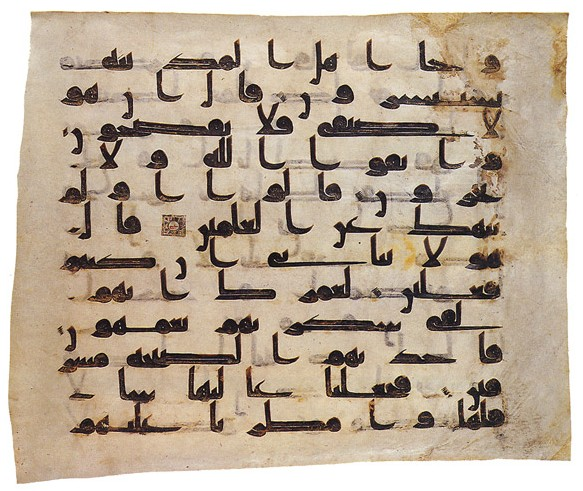
Image: An early Qur’anic manuscript (first half of the 1st century Hijri), Maktabat al-Jami’ al-Kabir, Sanaa, Yemen. Public Domain via Wikimedia Commons